Why does God never leave me?—that’s what I wonder sometimes. Yes, I know the answers, but sometimes it’s helpful to let yourself go there. It keeps you humble and concentrating on grace. And why is it that the more the heat has been raised in my life—whether by God’s fire of testing or my playing with sinful fire—or the more distant I once grew toward him, the more consuming were my thoughts of him?
Why did I never turn away when God felt too far to reach?
I may never understand any of it, except to know that when I would have run away, he simply wouldn’t let me go, or I, like Jacob in flight, ran smack into him any way I went.
When I lived in Indianapolis and trekked through a real spiritual wilderness, one day I was driving from my workplace and listening to a Catholic priest in a radio interview. I don’t recall the specific question he was asked, but it was something like how to explain people who question God or grow sullen in difficult times. I perked up. His response still resonates with me.
He stressed that people who wrestle with their faith often do so not to distance themselves from God, but to reach for him. I understood exactly what he meant. Hopefully that includes being angry at God, too. I once viewed anger at God as a terrible thing (who would dare!) until I got angry with him.
What I’ve learned is that anger and stressed faith will happen and is sometimes necessary in our process. The heart that truly loves God, however, does not shake its fist at him but strains to comprehend his will, to see in the dark. What may look like a fight with God to others (and sometimes to us) is but a fit of frustration to know him better. For me, I realized how ingrained faith was in my soul. Quitting God was no option.
“Whom have I in heaven but you? And there is none upon earth I desire besides you. My heart and flesh fail, but God is the strength of my heart and my portion forever. ” Psalms 73:25-26
After going through the ho-hums long enough, we gain insight. We learn to discern God’s designs for something foremost within us rather than any external conditions we need solved, although God works in our affairs, too. We also learn to measure the degree of our frustration. We may have our “moments” and get low on faith and stray and crave sin and smolder, but we do so with our faith mostly intact. We can only imagine what it would be like tackling life without God or the Holy Spirit’s restraint.
I’ve learned to latch onto this faith ride. I once had the notion that I could simply abandon myself to faith, as if setting a dial to make sure I remain in a proper state of heart. But now I realize that I cannot store faith and that God designs our process to deal with our specific inner needs. It is not possible to be passive in our own making. The heat that God brings into our lives is there to make us move! So faith is not a dial I can set but a wheel I must steer on my journey.
Not to be contradictory, I’ve learned to retain just enough indifference for it all not to matter so much. Don’t let that surprise you and if it does, stay on the journey—it’ll make sense soon enough. But take it all in stride. This is letting the top down to enjoy the sun and breeze and taking in the view, allowing God to care about the terrain we must travel.
“So in everything, do to others what you would have them do to you.” (Matt. 7:12)
The Prescription:Expect to be treated to the degree people perceive the respect you grant yourself.
How you treat yourself is a message to others of how they may treat you. It is a circular process that teaches us how to love and esteem ourselves highly.
When we are excellent in our own matters and affairs—like our health, attitude, and finances—we tend to become empathetic persons preferring one another’s well-being and dignity because we have, in effect, dignified ourselves. Our relationships improve also because our own lives have done just that as we’ve sorted out the kinks in our character. The obverse is that we will not treat others how we don’t want to be treated.
The Description:Our general manner toward others explains how we view ourselves.
People that truly love themselves and seek happiness and enrichment approach others hoping to connect with like quality. Those who belittle themselves are negative, distrustful of others, and hard-pressed to find any good in people.
Do you think I’ve overdone explaining this Rule? But we definitely act this way toward people we consider our superiors, perhaps for a prestige, title, or wealth. We do so because we feel there is something in it for us, not because we truly care. The deep insight of the Golden Rule is that therein we all become dignitaries, not for possessions but self-worth.
The lesson here is more than one of mere courtesy. It is a philosophy of self-respect that raises the quality of our lives and enhances the relations we share. Thus, we discover a social approach firmly rooted in personal integrity of character.
A little old lady regularly shopped the drugstore where I once worked. She always had a smile and a joke. Sometimes she would be nicely dressed and on her way to church, and she dutifully extended to me an invitation to visit. I made her a promise, indicating that I’d let her know when I was coming. I kept it on the back burner until it was simply time to make good on it.
I like visiting other churches. I like to see what community in other parts of the “family” looks like. Of course, there is the awkwardness of being the newbie anywhere, but that’s easily remedied by welcoming folk. I hoped for such people this time because I knew everything about me and this place was different, except Jesus. Still, I’ve preached a little everywhere, so acculturation was not difficult for me.
I went to the Sunday evening service. The little white church on the hill was quaint and about as dated as its congregation. Still, the people were very nice and cordial. I truly felt welcomed. I sat alone since my customer showed up just after the service began. Then it came time for the sermon. The minister, a senior but sprite man, ushered me into the most humiliating church experience I have ever had.
Somewhere after his intro, he started into a diatribe about this denomination, why it was right and why outsiders (like me) were on their way to hell. He taught and clarified, railed and complained, preached and evangelized straight dogma. I honestly wondered if this was what he had prepared for the people that evening because everyone else there, members of the church for years, certainly knew the script. I was the only guest present.
At times I nearly melted to the floor since it was evident that he was using the moment to give the visitor ‘a learning’ about why he didn’t have good religion. Then, I’d feel anger at his manner and entrenched ignorance. Everything he would say would cause something I learned in seminary to race to my wounds like white blood cells staving off infection. All that was left for him to do was point and say in a booming voice, “YOU, SIR!” and interrogate me on the spot.
What’s Your Motivation?
Why do we do this kind of stuff? I mean, at church, in our personal conversations, right here in the blogosphere? We regularly waste time arguing, criticizing, and lambasting others when we could be demonstrating the love of Christ to people who are hurting and conspiring good works that edify. Being factional is harmful; being right is counterproductive; making heretics out of people who only peeve us is not Christlike.
Behavior like this brings us into the condemnation of the ungodly minister described by Jude. In just 25 verses, Jude delivers a vivid, scathing criticism of false leaders that reads like an Old Testament prophet. He describes their glibness and failure to be conscientious in their speech and to weigh their words and actions. Jude skillfully references the fable of Michael the archangel refusing to be disputatious with Satan over Moses’s body.
And my point, using Jude’s illustration, is that if even an archangel wouldn’t allow himself to become reproachful of Satan out of respect for the Lord but opted to leave the matter with God, how do we cavalierly denounce our Christian brothers and sisters? Our methods may not please the Lord.
There are ways to deal with true spiritually destructive problems, but it seems that most of our squabbles result of our own pride. Let us not take the low road. We dishonor God and wreck the church in the process.
The following was originally an academic paper. I encourage you to incorporate this rich information in your study of Acts, Ephesians, 1&2 Timothy, and the Johannine writings. It is longer than most posts you read, but it won’t disappoint—promise!
The apostle Paul assigned his young protégé Timothy to Ephesus to oversee the affairs of the church there (1 Tim. 1:3). Paul was aware of threats opposing the gospel, and he sent Timothy to fight against an onslaught of heretical teachings. His primary concern was that Timothy guard the church by maintaining the truth of God’s word. He was to do this by carefully concentrating on its internal affairs.
Throughout the Pastoral Epistles (1&2 Timothy, Titus), Paul affirms the church’s presence in a spiritually dark world. If Timothy’s war within the church was difficult, the thought of confronting the sin and mindset outside the church was more daunting. Paul himself had spent three years in Ephesus (Acts 20:31) and knew that the spiritual climate there was rife with paganism, immorality, and relativism. This was the field of evangelism for the Ephesus church.
City of Culture and Pleasure
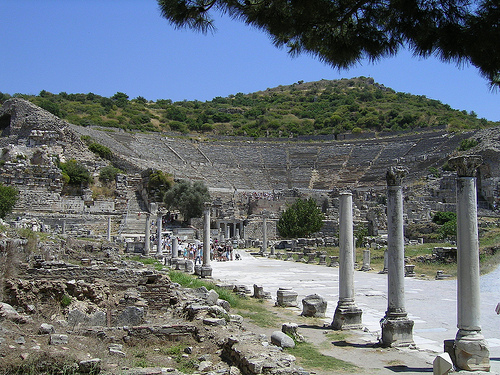
In the mid-first century, when Paul and Timothy ministered, Ephesus was the first and greatest metropolis of the Roman province Asia Minor. Little is known about its exact origin or the origin of its name. Grave relics place the founding of the city between 1400 B.C. and 1300 B.C. The story of Ephesus’ founding is legendary, its roots being traced back to the mythical Amazons, a race of female warriors. The city grew to become the premiere commercial, political, and religious center of Western Asia. The population ultimately rose to 250,000 by the third century, placing it third in size in the Roman Empire behind Rome (800,000 to 1 million) and Alexandria (300,000).
Ephesus was located on the western coast of Asia Minor on the Aegean Sea, and, as a leading seaport and the resulting trade, it swelled into a cosmopolitan metropolis. The city was the capital of the slave trade—the backbone of the Roman economy—from 100 B.C. to A.D. 100. The slave trade made Ephesus wealthy.
The city was also the meeting place for ideas from both the Eastern and Western cultural traditions of the empire. The scholarship of Ephesus was vast. Richard Oster and Markus Barth say, “It was well-known for its philosophers, artists, poets, historians, and rhetoricians. Ephesus made distinctive contributions to intellectual and religious history from the pre-Socratic period down to the philosophical revivals of the later Roman Empire.”
Ephesus was a city of culture where the people were distinguished by their amiableness, refinement of manners, luxury, music and dancing, and seductive arts that lead to vicious indulgences. The city hosted numerous festivals that attracted participants from other cities. Additionally, there was located there the world-renown Temple of Artemis, the library of Celsus, a 25,000-seat theater, temples dedicated to deities and cults, and numerous gymnasia and baths.
At the city’s center was the agora, or marketplace, a rectangular area 360 feet long surrounded by pillared halls, shops, and rooms. A sun and water clock was set in the open space. This environment entertained a multitude of hedonistic pleasures and philosophical ideologies that served to corrupt the moral consciences of the people.
Paul and Timothy’s Challenge
The ministry of Timothy and the Ephesian church cannot be perceived as anything other than doubly difficult. Paul and Timothy fought a battle on two fronts. One was definitely outside the church but the other was inside. Paul writes the two epistles to Timothy because he was well aware of the trouble Timothy faced at Ephesus having Judaism-loyal Jews right within the church (Acts 20:19).
Persecution by the Jews was prevalent at the time as well. Kenneth Scott Latourette says, “At the outset…the main persecutors of the Christians were those who held to Judaism and were antagonized by the fashion in which what superficially appeared to be a sect of Judaism was undermining institutions and convictions cherished by that religion.” This persecution was fueled by the church’s success in converting Jews and did not dissipate until there was further separation between the two religions.
O.P. and Barbara Reid provide an image of Paul and Timothy’s ministry in Ephesus. They explain that it is generally an unquestioned assumption that Paul was everywhere successful in ministry. Yet he must have found Ephesus challenging. Any success that he did have was most probably among ethnic Jews rather than the pagans of Ephesus.
Religious Relativism
What did the spiritual landscape look like then? Ephesus was home to the flagrant worship of more than seventeen deities and other cults. Dr. James Jackson explains what made this so difficult for the Ephesian church and other churches like it. He says that most pagan religions in Ephesus were either Greek or Roman, and Greco-Roman religion was without dogma. Any practicing priest at that time functioning in such a polytheistic setting would never make a claim to a unique validity of one set of rites or beliefs.
In addition, there was no religious prosecution. Just as there was no dogma, there would have been no need for heretics or martyrs. Religion was personal and unorganized, and there was no thought of denying the cults of other gods. The Greco-Romans viewed foreign gods as being like their own gods, although with other names. It would have been ill-mannered for one to assert the supremacy of his god above a neighbor’s “false” god. Such religious relativism provided the seedbed for a niche teeming with myriad forms of religion, cult, and superstition.
Artemis and Her Worship
The greatest of the Ephesian deities was undeniably Artemis Ephesia (of the Ephesians). She was first identified with the Anatolian mother goddess Cybele who was worshiped prior to the arrival of the Greeks in Anatolia (modern-day Turkey). Her worship was great, being called by Eugene Peterson “a pastiche of stories, superstitions, and systems of thought endemic to the ancient East that served Ephesus’ religious need.”
Artemis (Diana, her Roman name) functioned mainly as a city or local goddess, like most other gods and goddesses of the time. She undoubtedly contributed to the high feminism of the city, after all, a city founded by female warriors. Artemis served to protect (as a tutelary goddess) the safety and wealth of the people and their social institutions of justice and democracy. The wealth and security of Ephesus so attested to the power of Artemis Ephesia that other cities adopted her as their goddess. In fact, artifacts from her cult have been found as far east in the empire as Palestine and as far west as Spain.
Ephesus was the site of the world-famous Artemision, or Temple of Artemis, deemed one of the Seven Wonders of the ancient world. It was the largest Greek temple in antiquity, and the apostle Paul and Timothy would have seen it regularly. It was constructed on a huge concrete platform 238′ x 418′ (l) upon which sat the marble temple itself, 163′ x 342′. The roof was supported by 127 Ionic columns six feet in diameter and an astonishing sixty feet high. It is believed that the women of Ephesus sold their jewelry to help fund the project and that kings presented gold and furnishings to the temple. In 356 B.C., however, it was burned to the ground by an arsonist leaving only the four walls and a few columns. It was later rebuilt (completed in 323 B.C.) to match the splendor it had previously known.
The Artemision was Ephesus’ symbol of wealth. It served as a safe deposit of people’s personal wealth and offered loans to the public at a profitable rate of interest. The temple also boasted its own band of priests who were automatically and simultaneously officials of Ephesus and the sanctuary. Their job, however, was accompanied with ceremonial prostitution and other indecencies streaming forth from the temple center.
Artemis was depicted by an idol that supposedly fell from heaven. The upper part of the image’s front body was covered with rows of what appeared to be breasts that labeled Artemis as a fertility goddess, although this is uncertain. Coins that have been found bear this image of her, and it is with regard to this that Paul experienced the frenzied loyalty with which the Ephesians protected their goddess. Acts 19:23-41 is called the “revolt of the silversmiths” passage and refers to the trade derived from Artemis. Paul’s troubles come when silversmiths become alarmed that their trade is being diminished on account of the apostle’s preaching.
Other Deities of the Ephesians
Artemis was the main deity of Ephesus, yet there were a few other notable gods and goddesses there as well. Aphrodite (Venus) was the goddess of love. She was associated with phallic mysteries that usually resulted in the loss of virginity. Prostitution was common in her cult, including festivals honoring prostitutes and sacred prostitution. She was also celebrated as the goddess of hermaphrodites. In fact, there were several divinities that symbolized Aphrodite’s powers and were revered together. These included Eros (Love), Himeros (Longing), Posthos (Desire), Peithos (Persuasion), and the Horai (Seasons, Youths, Beauties). The personifications together contribute to a picture of erotic seduction all around Aphrodite.
Apollo, the Sun god, was the most famous and celebrated of all the Greek gods. Prophetic powers were associated with him, and his oracle at Delphi was world-renown for the counsel it produced on commercial ventures and political issues. Apollo represented order and discourse. Dionysus was Apollo’s opposite. Dionysus (Bacchus) was the god of lust and debauchery. His worship was associated with great festivals of wine, wild dancing and music, ecstatic revelry, and orgiastic excess, all too common in Ephesus.
Cabiri, a Phrygian god, was another ecstatic religion that had its roots in the primitive religion of the mother goddess from whom derived Artemis. It was also orgiastic in nature and involved scandalous obscenities. The cult of Asclepius was known for its miraculous powers of healing. As the Christian message of Jesus’s miraculous healings spread, his virtues were paralleled with the powers and wonders of Asclepius.
Other gods and goddesses worshipped in Ephesus included: Zeus (king of the gods and god of the sky), Gaea (goddess of earth), Hestia (Vesta, goddess of the hearth), Hecate (goddess of horror, witchcraft, and darkness), Hephaestus (Vulcan, god of destructive fire), Athena (Minerva, goddess of war), Demeter (Ceres, goddess of harvest and fertility); and the Egyptian gods and goddesses: Serapis (wonder-worker and protector), Anubis (Anpu, god of the dead), and Isis (goddess of family and motherhood). The Egyptian gods arrived in Asia Minor with Egypt’s merchant and military presence.
Then, there was always the imperial cult of Caesar and hero veneration. Hero veneration happened in Greek cities when certain individuals were worshiped for reasons that might have included benefactions, miraculous interventions, extraordinary civic or political contributions, or unique roles in the founding and history of the city.
This was Timothy’s field.
The city of Ephesus was a bastion of paganism, magic, and religious tolerance. The people gave themselves over to pleasures, revelry, and unimaginable sexual grossness. The authoritative words of Paul were challenged at every point, and even demon counterfeits seemed to rival any true spiritual manifestation of the Spirit. Timothy had to refute damnable teachings within the church, then look into the culture and preach the exclusivity of an inclusive God and kingdom. How was he to bear the task?
A Gospel Legacy
It is proper to think of the ministry of the Ephesian church as difficult but not impossible. The words of Paul to the Ephesian church the last time he would ever see them are befitting:
Be on guard for yourselves and for all the flock, among which the Holy Spirit has made you overseers, to shepherd the church of God which he purchased with his own blood. I know that after my departure savage wolves will come in among you, not sparing the flock; and from among your own selves men will arise, speaking perverse things, to draw away the disciples after them. Therefore be on alert remembering that night and day for a period of three years I did not cease to admonish each one with tears. And now I commend you to God and to the word of his grace, which is able to build you up and to give you the inheritance among all those who are sanctified (Acts 20:28-32).
Paul knew that after his departure teachers would attack the fledgling church from all directions. Any other person looking at the situation might have questioned the survival of the church. Nonetheless, Paul trusted the power of the grace of God, and it is with those hallmark words, that benedictory blessing, that he could count on the survival of God’s work in Ephesus.
Timothy’s Death
John Foxe, in his Book of Martyrs, relates that Timothy died in Ephesus in A.D. 97 at the hands of pagans celebrating the Feast of Catagogion. This feast was held annually in Ephesus on January 22. Men would run about the streets in a frenzy dressed in outrageous costumes with clubs in-hand carrying images of their gods. They would rape women they encountered and beat or kill the men. Foxe says that Timothy met the procession and rebuked them for their “ridiculous idolatry” so enraging them that they beat him severely with their clubs. He died two days later of his wounds.
“Just a bunch of Mexicans that should be shipped back to where they came from! They’re all illegal, here taking our money and sending it to Mexico. They just need to leave!”
“My goodness, the gays! These folk are demon possessed: men have a female demon and women have a male demon. They need deliverance. But I ain’t got time for them.”
“Can you believe some Muslims just moved next door? Things are gonna start getting bad around here. You can’t trust them because they’re surely up to something.”
“There were some foreigners in the grocery store the other day blacker than me—I mean b-l-a-c-k—and they’ve got the nerve to think they’re better than us.”
These were real comments I heard made by professing Christians that caused my heart to sink. I cannot understand why people who say they are Christians can feel so graceless and speak so ruthlessly about people with whom they should be sharing the love of Jesus. When I hear these kinds of comments coming from Christians, I’m tempted to go “Jesus vs. The Money Changers” crazy and shut everybody down. But enough is already written in their Bibles, which they are obviously not reading well.
Have you ever felt like one alone on an island in the middle of the ocean? I know there are a host of other Christians around me striving to walk in the fruit of the Spirit; however, the journey for me gets lonely sometimes when the faithful seem to cling to worldly notions more than taking their cues from Christ. I just don’t get why loving God and people is a Christian essential for me and not for everyone else.
Getting Down in the Pit
Maybe the question needs to be reworked. So let me start by addressing the two issues—homosexuality and xenophobia—in the comments above and use them in proxy to address the issue of loving others whoever they are.
Many Christians don’t know how to talk about homosexuality without feeling they must come down hard on it lest they be viewed as condoning. Yet the very ones who would claim they love everybody could never really have a friend who was gay, a person they could act the fool with, respect, and enjoy life together, because their own faith would be a jagged blade between them stabbing both ways.
I consider homosexual behavior sinful. But I also know that the deepest differences of opinion on any subject don’t necessarily have to divide. Christ’s approach was always toward the person. He understood that getting some people (of any habit) out of the rut might mean having to jump over into the slum with them and pulling them out. (No, I’m not advocating any type of gay therapy.) Why? It’s because people—those bearing the image of God—have primacy in the heart of God, and no distance is too greatly traversed to recover them. (I cover this topic in-depth in Communication Barriers Between Christians and Gays.)
It reads simply but is quite profound: We like to say that God loves the sinner and hates the sin, which is very true, but it doesn’t get us to what we need to see. Jesus shows us a God who chooses love for people over his contempt for sin. God, who is perfect love, hates sin with perfect disdain and yet his love for humankind is preferred to his love and need for justice. Thus, space is created for pardon, for redemption.
So for Christians, loving others with God’s heart is transforming to the one who receives it, and if that’s not happening, the problem is not with God.
As it relates to other cultures and people groups, Jesus was often criticized for associating with street people and those of the seedier side of society—and by those who felt they had a handle on their own righteousness. (Read “People of Your Kind!”) But Jesus’s message was broadly inclusive of everyone, especially the outsider.
It isn’t just the Great Commission where we are told to go to the four corners of the earth with the message. Jesus predicted (in Mark 12:1-12) a spiritual “fumble” that would bypass God’s chosen and bless the Gentile first in a way unintended. Further, in Christ’s final embodied scene in the Gospels, he instructs the disciples to wait for the Holy Spirit—the one who would enable them to bridge the barriers of culture—and take his message, as if in ever-widening concentric circles, to Jerusalem (home), Judea and Samaria (city, state, nation), and to “the ends of the earth.”
Crux of the Matter
So I come to my reworked question: What made Jesus so approachable? And, he being God, why was it easy for him to mingle with sinners? It is more of that which we so desperately need. Moreover, why can’t all Christ followers see that loving God through people really is a Christian essential? What Christ shows me is that the faith God offers is amazingly well suited to human need. To say even this is an understatement, for God has made us to need him. It is a wonderful thing that is sorely missed by those who take the lesser road.
God needs us Christians to acquaint their Lord. Without intimacy we will not have God’s heart or understand his ways. We must live in the words of Christ, think through the scriptures, deliberate with our faith, and follow the Holy Spirit who reveals Christ perfectly. When we do, we’ll lend credibility to the Christian name and others will come to know the Lord, if only by observing that he truly dwells in us.
Getting to the table on matters of faith is hard for many people, while behaving there is another for some. Sometimes I am amazed at postulation I hear when people are backed into philosophical corners. I recall myself leaving a philosophy club meeting at my Christian university fuming at peers who blamed God for creating evil simply because they could not arrive at a logical answer for it.
Since seminary I have always stated that I begin my personal study of theology—apart from my faith in God’s existence and perfect goodness—with a large dose of “I don’t know.” That stance helps me appreciate the mystery and keeps me searching for truth. Why is the deepest question about life and its most elusive. We are all spiritual seekers, and we have, at some point, found ourselves caught up in some eddy…some wave…some tide in the ebb and flow of higher truth.
I respect those people who fight to know, who wrestle with truth and seize upon the life of faith, although for them it comes in flickers and glimpses. Some people, however, give up and cease all inquests, grow intellectually antagonistic, and never recover from their lack of spiritual knowledge, something I hate to see. I would like to believe that a period of searching is not unlike a teen who goes through turbulent years only to recover his or her “sanity” and grow into a model adult. But my own doctrinal beliefs about sin and fallen humanity disallow that.
Reaching for spiritual truth—to know if God’s resume is really what he claims it is—is normal, even for Christians, and will traverse the breadth of human speculation and emotion. If you’ve read Psalms, then you know exactly what I’m talking about. Sometimes it is the only way we can be sure that the faith we possess is able to sustain us. But to overreach only does harm to the person. Overreaching means to bail out and surrender to intellectual suspicion; to give in to the mental and emotional need for stasis; to bring God up on charges; and, at worst, to walk away from faith.
Is There Purpose in Everything?
These sentiments often surface with moral topics and hot-button issues. I once watched a talk show and a question came up concerning autism. “Is there a purpose for everything, including disease?” I think everyone nodded their heads and agreed as a way of making sense of it and sympathizing with the suffering family. But something didn’t seem right to me.
Based on my spiritual convictions and the wisdom of Christian teaching, I cannot believe that disease possesses purpose and moral value. Unfortunately, sickness and disease occur, and why I don’t know; but they have never been part of God’s revelation or intent for humankind. I could never imagine anything less than goodness and goodwill in God’s character, in his Heaven, and in the original world he created. Again, to say otherwise, I feel, is to overreach.
I am not sure all things have purpose and moral value, and some things, like disease, may exist in a state of failed purpose. I don’t know, and, trust me: I’m not trying to be the philosopher here! But to assert that all things do indeed have purpose, from my Christian standpoint, may be leading to the justification of evil and sin’s existence in the world. (Research theodicy, the problem of evil, for more discussion.)
I will not bend my mind to accept something as true simply because I do not understand it. A better approach might be to realize that although some things are mysterious and without apparent purpose, and perhaps consequently evil and used (by Satan) with evil intent, they can be used purposefully, but only if one possesses the power to cause it.
Only God has the power to use all things in purpose, and here would be a good starting place in understanding his omnipotence and lofty wisdom. Thus, I cannot say it better than scripture itself has done: “And we know that in all things God works for good to those who love him, who have been called according to his purpose” (Rom. 8:28).
“Master, carest thou not that we perish?” This is Mark 4:38 in the King James Version. I love its poetic tone. If it were you or me today, about to be marooned at the bottom of the sea, we’d say, “JESU-US! Get up! We’re about to die here!” Jesus must have been “in the zone” when the disciples shook him awake, fear in their eyes.
Moreover, their inquiry, so rhetorical and profound, is quite revealing of our human limitation. Plight and hardship comes to everyone in some way. When it enters our lives and we’ve reached the limit to what we can handle, we often frantically search for answers using questions that would be reproachful and unthinkable in an ordinarily peaceful state of mind.
“What did I do to deserve this? Am I so evil that…? Do you really love me? If you’re God, then why don’t you just…?” We become sarcastic and harsh, not unlike the Israelites—“You mean to tell me we left our life in Egypt to get out here and waste away?” It’s not just the sinners who talk to God this way; the saints do it, too, when the heat gets too hot, if only in their hearts.
I am not being critical; if it helps, I’ve been one to gripe this way. And I’m certainly not defending God who regularly demonstrates his capability of handling our weakness. I can appreciate the fact of my limited capacity; it’s part of our nature. But there will be times in life where a higher level remedy is needed, and, thankfully, it is available to us. Further, it’s useful to pause and reflect with some sense of self-estimation. I am frail; God is strong. In his wisdom, he permits the storm from time-to-time to help me discover my strength in his or to prove it.
Pain is never easy but always purposeful. When God allows a storm in our lives, he uses it within his plan. We should always be better after storms than before them, but the outcome isn’t the focus here. This is not unlike storms themselves: they (and God) don’t give us time to focus on conclusions lest we miss the lessons God is attempting to teach us. Storms must be endured, for it is in our persistence, not our escape attempts, that God reveals things about us and him. We must trust him that we’ll land safely ashore when it ends.
God uses pain in our lives to make us move and achieve mature responses he’s waiting on. Hardship always forces us in some way: to uproot, to plant, to build, to tear down, to eliminate, to renovate…something. The “fire” puts us in action.
When I was a boy, one summer day my brother and I (with adults) had to cross a newly paved thoroughfare in our town on a very hot, cloudless day. We decided to do it barefooted! (The pavement was so smooth and beautiful, okay!) We assumed that the road wasn’t all that hot, plus we’d be on the other side in seconds. Unfortunately, we got halted in the middle of the road by oncoming traffic for far longer than we expected, and our shoes were inaccessible to us. Drivers got a free hootenanny that day! Our poor feet nearly burned to nubs!
Likewise, the heat in our lives is a grace that jolts us into action to achieve results God desires for us and that we would certainly desire for ourselves.
The storms we go through are tough, but God, addressing our questioning and limited understanding, explains that it’s designed to be that way. Yet we have his promise that the storms will never destroy us. When we have nothing more to latch onto for help, we will learn to cry out for God, which should be instructive. God desires to show us how reaching for him and his spiritual provisions should be our first response in whatever we face, whether times are good or bad.
I imagine that in their moment of fright the disciples were certain that everyone, including Jesus, was going down. Isn’t that like our human frailty, to see God as subject to the terms and conditions that life places on us. And that’s when the Lord makes a demand: “Where’s your faith?” Not that we possess no faith…not to berate or belittle us, but to call out of us, with the same authority he rebuked the wind and sea, the faith lying small within.
True godliness has a way of making self-righteousness expose itself. Time after time in the Gospels, we find the religious leaders at odds with Jesus for something: his miracles, his teaching, the disciples, Sabbath violations. He could do nothing right in their eyes when all he ever did was good. He was also in constant trouble for his associations.
In the Gospels, Jesus catches flak for keeping company with two people of the same trade: Levi and Zacchaeus, both tax collectors. The scriptures clearly express the disgust the public bore for tax collectors, but that contempt wasn’t without reason. Let me explain.
Who Were the Publicans?
Rome ruled Judea at this time. A system of tax farming had already been established by the Roman government more than 100 years earlier. This system was a method of reassigning the responsibility of collecting a tax. The censor, with various public agencies including some financial duties, and concurrently with his five-year term, leased out public revenue for a region into the hands of the highest bidding private citizens or groups (companies).
These persons (NT: chief tax collectors) would pay fixed rents into the treasury and receive the right to make a profit on the revenue for the five-year term. Then, they would hire others (NT: tax collectors) who would actually deal with the public and collect the revenue.
These publicans, a term used for all tax collectors and other roles they served, were held responsible for any losses. So abuse pervaded the profession, namely extortion, not only to ensure the full revenue, but also to allow the collectors to make the most money they could. Dishonesty was more than common; it was expected and generally true of publicans.
In Judea, tax collectors were Jews and viewed as working for Rome, extorting fellow Jews. The scorn was immense. They were degraded as the worst of sinners. They were ineligible to be judges and even witnesses. Their families were stigmatized by the profession so that it would be clear in a court of law that such persons were probably untruthful, also.
More than likely, people took up the publican profession with a view of getting wealthy because the law permitted their abuses by turning a blind eye. Publicans knew they wouldn’t be liked, and I imagine most were ambitious, aggressive, thick-skinned individuals. In the Gospels, Matthew is a tax collector in Capernaum and Zacchaeus is a chief tax collector in Jericho.
Jesus, Full of Grace and Truth
So “pretty shocking” is an understatement in expressing how people feel when Jesus dines with both Matthew and Zacchaeus. Mark describes Jesus as eating with “tax collectors and sinners” (2:15), and the Pharisees, the moral police who always seem to hang around Jesus, got fed up and pulled the disciples aside and asked why. Jesus spoke up: “It is not the healthy who need a doctor, but the sick. I have not come to call the righteous, but sinners” (v. 17).
Be very afraid when religion grants you “Me and Jesus” status and makes everyone else outsiders, even if they do bad things. The only way we can save sinners is by empathizing with them, which forces us to remember that once we didn’t have ourselves together either. Jesus found us somewhere in a dump, even the best of us. This means, we have something in common with the sinner, whether it is the same sin or simply our fallen condition. We fully understand what it’s like to be in sin and to struggle with it daily.
And what a personality Jesus was! He forced the religious to recognize their graceless, entitled, self-righteous ways and transformed those who had set religion aside to indulge their sin. Further, he wasn’t afraid to engage sinners. He went where they were, and this must have made a statement to them about his character. Sometimes we don’t approach people because we’ve scandalized them—we’ve turned them into their vice. When we do that, we shut the door of grace to them.
“She’s a prostitute.” “He’s gay.” “They sell drugs.” “She’s a gang leader.” These are “bad sins” and, in our eyes, they make these people unreachable. (Did you hear all those doors slamming?) But Paul says, “And such were some of you” (1 Cor. 6:11).
Let us never forget that just because people choose a wrong path, not only does it mean that grace remains available to them, it more importantly means that they’re not immune to being hurt by how people treat them. They’re still people; words and characterizations still cause pain. Christians, especially, run the risk of pushing these folk away from God forever if we don’t prove the great love awaiting them.
Jesus finds worth in Matthew; he calls this tax collector to preach his gospel. To Zacchaeus, whose wealth Luke candidly acknowledges, Jesus announces, “Salvation has come to this house” (Luke 19:9).
In Luke 18:10-14, Jesus tells the parable of—guess who?—the Pharisee and the tax collector, in the presence of the Pharisees. (Can it get any better!) It is riveting and emotional and a great final word on this discussion:
Two men went up to a temple to pray, one a Pharisee and the other a tax collector. The Pharisee stood by himself and prayed: ‘God, I thank you that I am not like other people—robbers, evildoers, adulterers—or even like this tax collector. I fast twice a week and give a tenth of all I get.’ But the tax collector stood at a distance. He would not even look up to heaven, but beat his breast and said, ‘God, have mercy on me, a sinner.’ I tell you that this man, rather than the other, went home justified before God. For all those who exalt themselves will be humbled, and those who humble themselves will be exalted.







 A 'Mike' for Christ