Stay Low: A Spiritual Life Lesson

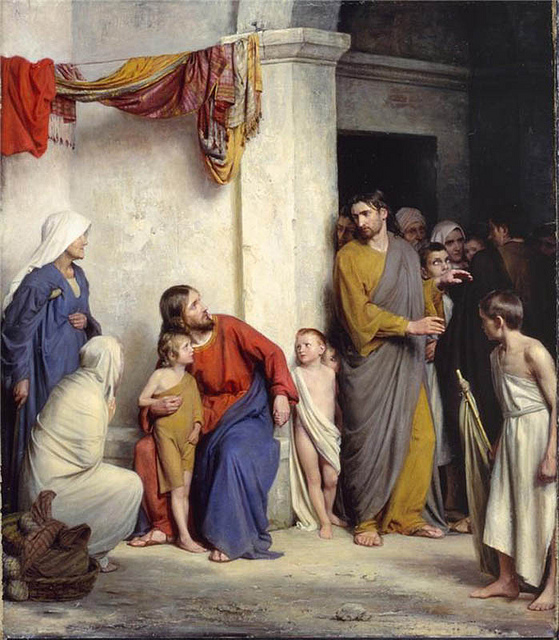
"Suffer the Children to Come to Me" by Carl Bloch, Frederiksborg Palace, Copenhagen (Domain)
“Suffer the Children to Come to Me” by Carl Bloch, Frederiksborg Palace, Copenhagen (Domain)

That Sunday morning was too hot and muggy for anything. But that’s summer in Japan. I and a newly-arrived co-worker had a half-mile hike to the church after a short train ride. Without a cloud in sight, the sun was merciless and exacerbated the strain of the uphill trek; we walked fast to end the baking quicker. This was my first church service since my own arrival two months earlier.

When we arrived, sweating and exhausted, we couldn’t figure out what we were seeing. We had already been met by running water and now we saw why. Everyone was outside standing around a long bamboo chute with water running through it…not the usual Sunday doings. Someone at the upper end dropped noodles in the water, and people with chopsticks—a pair of which I was quickly handed—feverishly grabbed at them to catch and eat. The summer tradition is called nagashi-somen and everyone was having fun.

I knew I was gonna like this church.

Almost immediately I met the pastor, Bo Dellming. He was a tall, jolly fellow, the very idea of the word “parson”. That day was the beginning of a meaningful pastoral relationship with Bo; I continued attending the church from then on.
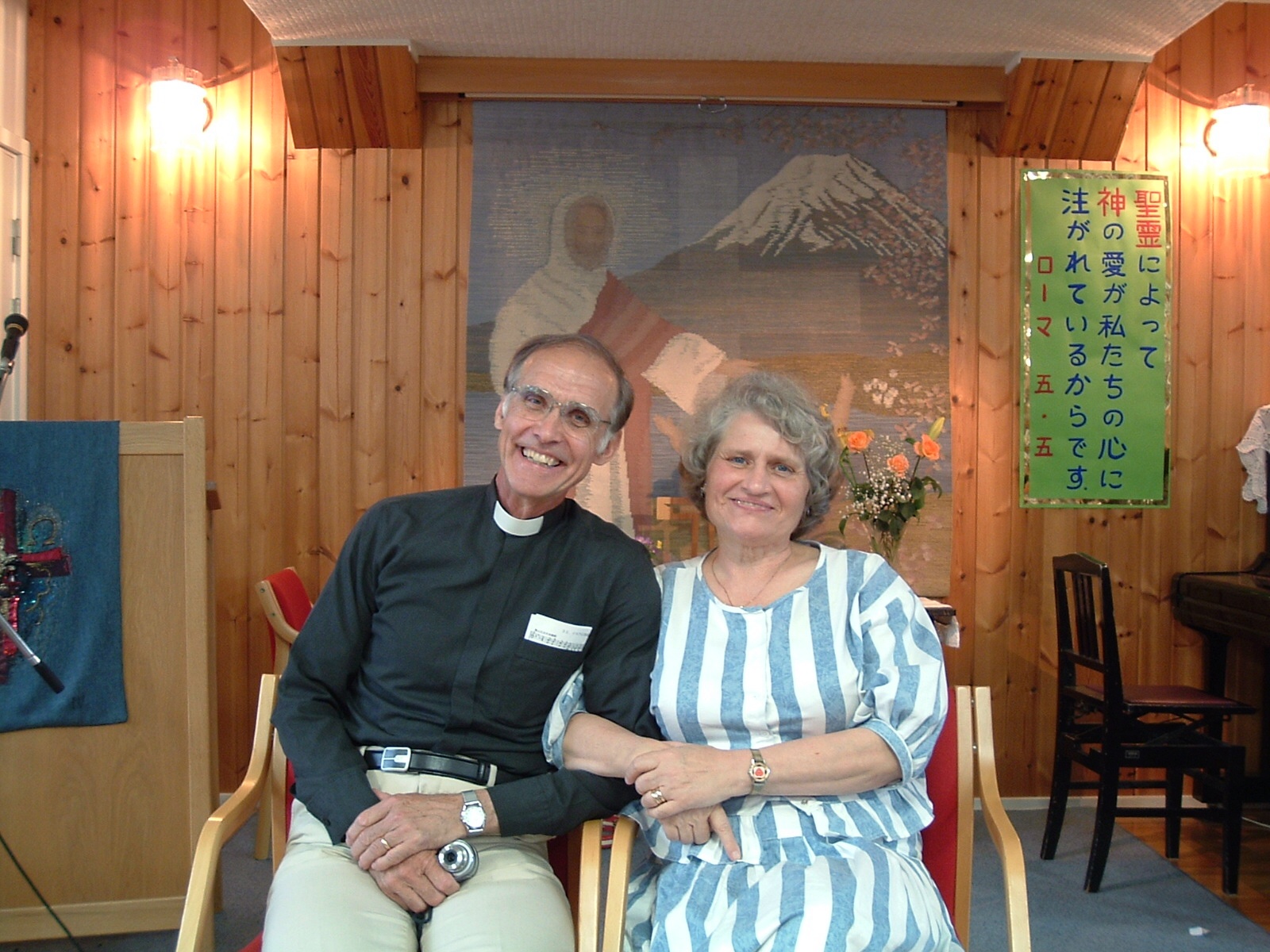
Bo & Kerstin Dellming

Good and Faithful Servants

After accepting Christ in his early 20’s, Bo, a Swede, determined that he owed God his life and decided to attend Bible school. Upon graduating—it’s funny to hear him tell it—he discovered an ad in the local newspaper calling for people to serve God on the mission field in Japan. He knew nothing about Japan, but this soldier had found an opportunity to serve. So throwing all caution to heaven, Bo became a missionary in Japan and never looked back.

That’s been over 50 years now.

Kerstin, his wife, also Swedish, hails from a ministry family. Her parents were missionaries in China, and her father was a Bible translator there.

The Dellmings have long since mastered Japanese and have unceasingly forged ministry in the spiritually dark country. In addition to raising their own family, a few generations strong now, the Dellmings have built a devoted congregation and a charming Swedish-inspired church and parsonage complex in Fuji City, which is Takaoka Chapel/Fuji Christian Center.

Stabbed with Love

Pastor Dellming is a compassionate man and it shows in his teaching and leadership. Whenever I was with him, I saw Jesus—plain and simple. No one has emulated Christ more to me. He is certainly a soldier for Christ but the kind devils don’t expect: the ones who love the hell out of people. Don’t discount that type of warfare. It’s real, although the enlistment is small.
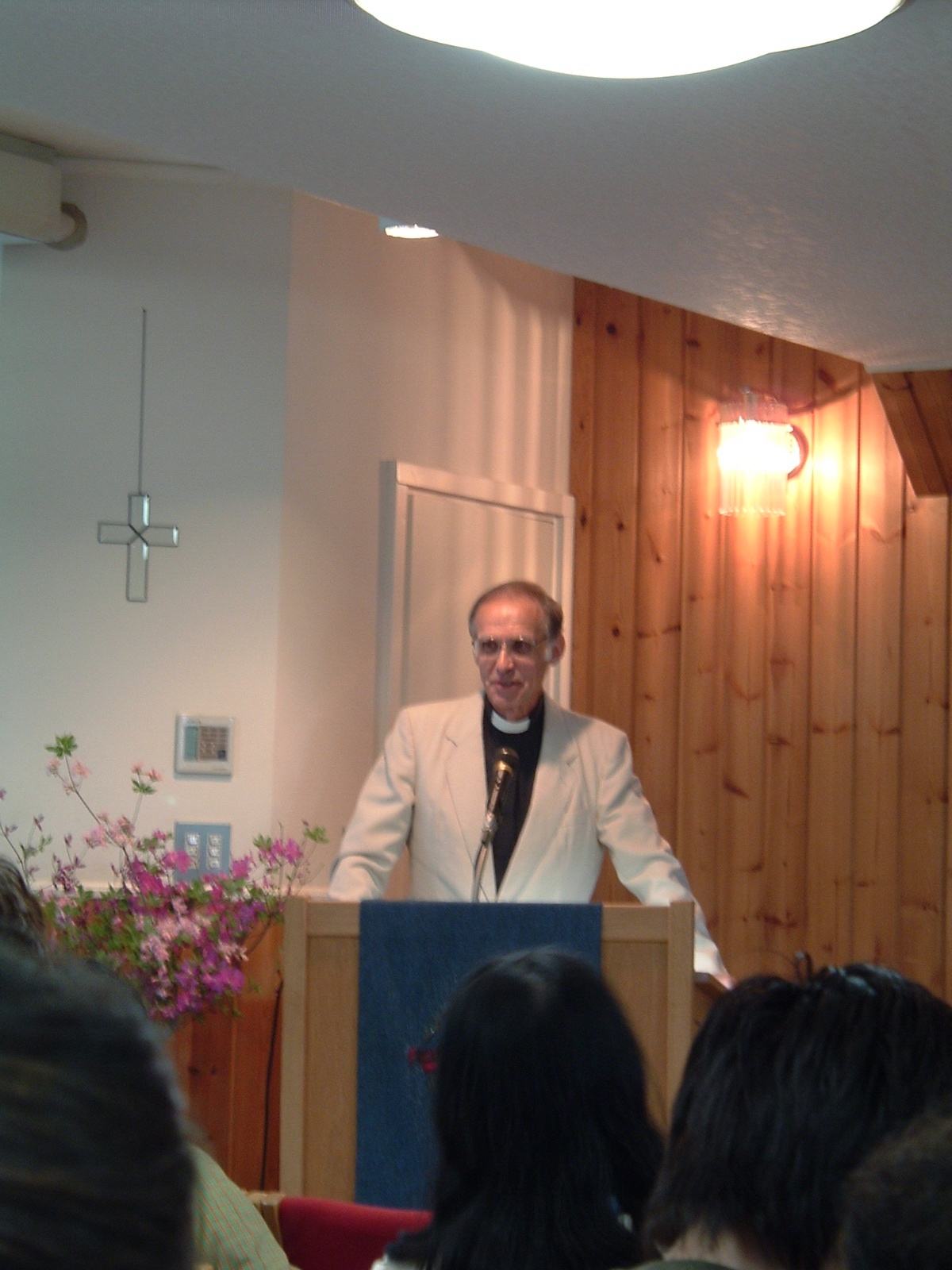
Pastor Dellming preaching

Pastor Dellming did something one Sunday so simple yet impressionable to me that it brought tears to my eyes, as it does this moment reflecting on it.

In Japan some churches will provide a small supper to attendants after the service; at Takaoka Chapel this was usually a curry rice dish and at other times it might be a full lunch. Moreover, it was always a pleasant time of fellowship. Thus, once the service ended, all the chairs would be moved to the sides and two long table rows would be created for all who remained to eat.

This particular Sunday there were many people at the supper and lots of children. After Pastor Dellming returned from greeting some outside the church, I recall him walking in beaming like Santa and playing with the small children. He loved them and they loved him.

He looked at me and remarked how they liked to ride on his back; and straightway this not-so-young man dropped to his knees and let the kids hop on for a trip through the open church. What humility!, I thought. I tingled with joy watching it happen and could hear Jesus rebuking the disciples—“Don’t you dare deny them from approaching me!”
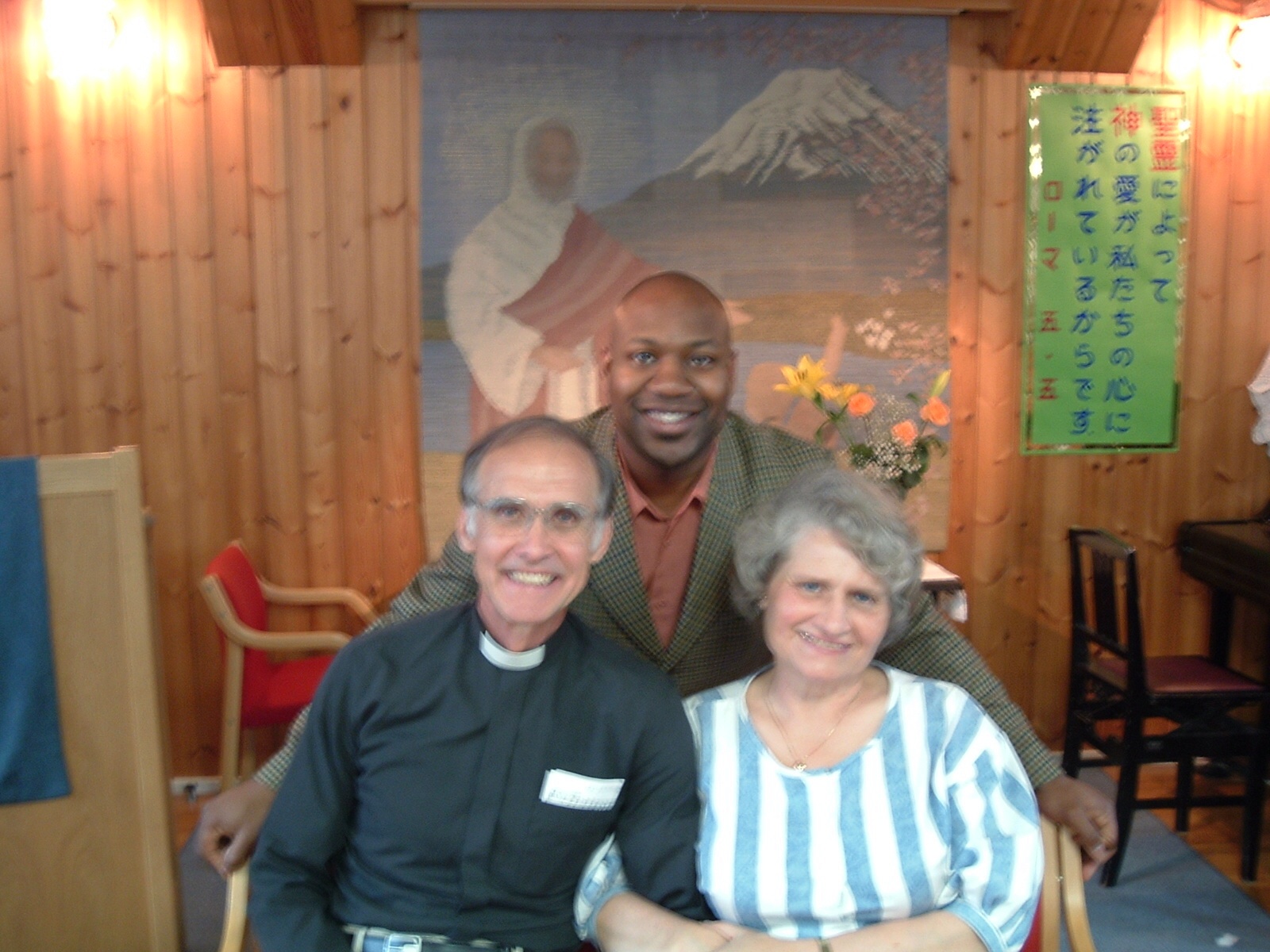
Me and the Dellmings

You Who Would Be Great

It was one of the best things Pastor Bo gave me, a lesson on humility. No matter how high God takes you, Michael, be like a child. This from a man who would only see how much more was left for him to do for Christ.

Jesus, responding to the disciple’s griping, answered the question of greatness in the kingdom by calling a child over and declaring, “Truly I tell you, unless you change and become like little children, you will never enter the kingdom of heaven…whoever takes the lowly position of this child is the greatest in the kingdom” (Matt. 18:3-4).

In other words, be teachable. Don’t get caught up in your own hype. We are nothing; God is everything. Divest yourself of empty ambition and seek only to serve him and as fully as you can. Learn that the highest place in God will always be at the feet of Jesus.

 Pastor Dellming passed away in October 2016. His wife Kerstin survivies. 

Showing Grace to Ourselves

POINT MADE ALREADY, YOU SAID? (LOL) CC BY-NC, guccio@文房具社, Flickr
POINT MADE ALREADY, YOU SAID? (Ha!)
CC BY-NC, guccio@文房具社, Flickr

Many people are their own toughest critic. I am. But what’s unhealthy is treating oneself with disdain, and that has been a problem for me at times. I will speak to myself with severe contempt at my stupidity or failure or some other thing.

It wasn’t until the Lord, in his gentle way, checked me one day about it.

What he is teaching me is to not treat myself the way I would never treat another person. Get that: God instructs us to do to others as we would have them do to us, yet I was doing to myself as I would never do to others or allow them to do to me.

I could hear the Spirit within—“Stop saying that.” Then, one day the message became clear: You are a recipient of the grace of God; it dishonors him for you to dishonor yourself. Christ paid too high a price for my well-being for me to side with the Evil One in my attitude about myself.

YOU are Important to God

We are to love our neighbors as we love ourselves (Luke 10:27), or with the same care we show for our own bodies and concerns. The scriptures assume our individual welfare prior to our interaction with others, which is only natural. Paul says, “No one ever hated their own body, but they feed and care for their body” (Eph. 5:29).

Look at common clichés: “Take care of home first” and “Health is wealth”—because if I’m in poor health, or die…

Hear Paul again: “Therefore, as God’s chosen people, holy and dearly loved, clothe yourselves with compassion, kindness, humility, gentleness and patience. Bear with each other and forgive one another if any of you has a grievance against someone. Forgive as the Lord forgave you. And over all these virtues put on love, which binds them all together in perfect unity” (Col. 3:12-14).

So the Lord says to me and us all, why is this any different for you…by you? Cast away fear, regret, worry, and other negative emotions by remembering that you belong to God and are in the grip of his perfect plan for you. He’ll help you sort out the kinks.

More: The Golden Rule and Who Is My Neighbor?

Hell or High Water

My Justin Work Boot Credit: JustinBoots.com
My Justin Work Boot
Credit: JustinBoots.com

This post is inspired by Kate Bortell’s “Wearing Wellies in the Rain”. I hope you’ll acquaint Kate, a truly delightful person, and kick back with some tea and enjoy her folksy, whimsical posts.

I worked on the railroad for a brief time. It’s an experience that never bores, although there are aspects about the job that are truly unenjoyable: the harsh schedule, work at any hour of the day or night, and the dangers of being in the thick of nowhere not knowing who or what is watching. Oh yeah, getting run over or crushed isn’t consoling either.

Trainmen also have to work through any weather condition, so it’s important to know the forecast and not lack proper gear. I was lucky enough to forget rainwear on the one day of the year Noah decided to return for a visit. The most important required gear, however, is footwear, work boots. They’re crucial for riding the cars and walking on the ballast, among other things.

Working on the rail was the first time I ever donned work boots, and it was a new experience for me. Further, I bought a pair of loggers—you wit me? Anyway, I knew what Justin (the manufacturer) told me about my boots and assumed that my $170 meant I had a good pair that met railroad guidelines…that’s that.

During a job one day following nearly two weeks of rain, we had to stop the train and figure out a move. I had to exit the engine and get over to the other side of a gully that was swollen with water; it was a virtual pool. The only way I could reach the other side was by jumping far enough and landing on as much soil as possible without soaking myself. It was doable.

So I leapt.

Nevertheless, I still ended up in some water. In fact, I stepped so far down into the pool that I waited to feel my precious boots filling and my feet swimming. But nothing. I got up on the hill and still nothing. My thick, heavy, waterproof work boots were so well-made that six or seven inches of water didn’t matter. I couldn’t believe it.

Dry Feet in Wet Places

This story makes me think about the Hebrew boys: Shadrach, Meshach, and Abednego. And what it causes me to reflect on are the hard places that we’ll inevitably encounter in life and the tough choices that will attend them. We’ll even make the right decisions but still come up short.

There are going to be situations that you know will be as the cliché goes—“all over but the crying.” But it will be in those moments that God will let you see and experience all the prayers prayed on your behalf, all the worth of your service, the full backing of Heaven that has always been yours. For every protection was built-in and has been with you from the start.

Your feet will keep dry; your clothes won’t burn.

“When you pass through the waters, I will be with you; and when you pass through the rivers, they will not sweep over you. When you walk through the fire, you will not be burned; the flames will not set you ablaze.” (Isa. 43:2)

This Faith is Not for Wimps

CC BY, Stephen A. Wolfe, Flickr

I consider myself a city boy provided that you understand “city” in my history is originally Nowhereville, USA. So it’s a choice kinda thing. I enjoy studying cities and I like city life and have been privileged to visit some pretty big ones—the biggest, in fact, which is a true marvel.

Yet I feel more at home in the outdoors. I love nature. Words like rustic, sylvan, and bucolic stir me in ways the words modern, skyscraper, and metro never do.

Being sent outdoors as a kid was not a punishment. Later I would work and participate at several camps and a few jobs that were pretty hands-on. I’ve always admired the manual life, although I am regrettably not the son bitten by that bug. (My mom is a seamstress, so I could’ve been a tailor by now.) I’ve said 101 times that the person who can work with his or her hands will survive much easier should the world go belly-up tomorrow.

Compete to Win

As I’ve grown older, I’ve increasingly desired the physical, outdoorsy life. I envy those who grew up on farms, ranchers, and just the skilled laborer. I’m sure they have much to share to slap me back into my reality, still…

The physical, labor-intensive life is to me a fitting metaphor for the character of the spiritual life. Our faith certainly creates a refined product, but the nature of the tool is duly rugged.

I discover this truth all through Scripture: in the agonized prayer of Hannah crying out to God for a son; in the Psalms’ tightly framed shots of human emotional investment made in worship; in the implications of scripture, like grief as a spiritual act of sowing.

I notice it in Jesus’s bold yet nimble teachings to go the extra mile and love the vilest; to “have faith” in an ardent way; to know that if the kingdom will be had, it will be found; to remember that the way up is down; and to make sure we count the high cost of serving him.

Do you see it? Do you notice how tough and gritty, coarse and earthy this life of faith is? Every Christian will surely taste his own sweat and feel the grain in his mouth.

Works in Progress

Tools for cutting and refinement are necessarily sturdy. Wood isn’t going to carve wood, is it? Clay won’t shape clay. They need a sharper and more durable tool to give them form.

The faith God has given us is definitely durable and sharp enough—in his hands and in our spiritual practice—to whittle away at our knarls, imperfections, and stony hearts until we become works of beauty, transformed by his grace. It turns Jacobs into Israels and makes Peters out of Simons.

BUT… “No one who puts a hand to the plow and looks back is fit for service in the kingdom of God” (Luke 9:62). This isn’t for cowards. It takes dexterity and resolve to apprentice this carpenter.

Brethren, We are Not Superheroes

CC BY-NC-SA, Rev. Xanatos Satanicos Bombasticos (ClintJCL)

Picture this: a well-written movie with a strong plot, a hearty dose of conflict, a beloved protagonist, and a cruel villain; at the end of this movie and climax of all suspense, the good guy dies horribly and the villain escapes.

No, you said? The bad guy isn’t supposed to win, right? Instead, he’s supposed to get what’s coming to him. Unexpected endings often make or break a movie in our minds because although evil might reinvent and resurrect itself, good should always win the day. The bad guy must be whacked.

“I Am Not Like You”

We possess a moral urgency to see truth prevail and justice done to all wrongdoing, and it comes alive in us most days just from watching the evening news. That inner urge derives from the image of God in us. It is our inbred ethic and the assumption of God’s moral law alluded to in Romans 1.

God has granted authority to government to prosecute wrongdoing, and Paul refers to government and its officials as the servants of God for good (Rom. 13:1-8). To individuals, however, and believers specifically, Jesus and the New Testament draw clear lines between owning an urgency for truth and justice and personal retribution on others—evildoers, sinners, and neighbors alike. Focus closely on this insightful intro to Luke 13:

Now there were some present at that time who told Jesus about the Galileans whose blood Pilate had mixed with their sacrifices. Jesus answered, “Do you think that these Galileans were worse sinners than all the other Galileans because they suffered this way? I tell you, no! But unless you repent, you too will all perish. Or those eighteen who died when the tower in Siloam fell on them—do you think they were more guilty than all the others living in Jerusalem? I tell you, no! But unless you repent, you too will all perish” (vs. 1-5).

Jesus Makes His Case

Jesus raises four points. First, bad things that happen to people don’t imply their sinfulness or wrongdoing in any way. We have to be careful of this karmic notion and that we are not wishing evil upon others or rejoicing because “they got what was coming to them.”

Jesus lets us see that God is not hell-bent on retribution, like us. In fact, Psalm 103:10 explains, “He does not treat us as our sins deserve.” But humans are indeed vengeful; we are morally fallen and ethically confused.

Second, we should guard ourselves from the sin we assume in others and remain humble before God. Whether we are sinners or believers, sin’s effects are equally devastating. This was Jesus once again turning the tables to deliver an irrefutable point.

The third and fourth points come by implication. So, third, God is good to all, yet bad things happen to good people. A noted preacher spoke in one of my college chapel services not long after 9/11 and said, “The people who went to work that day didn’t hear God.” I sat there stunned by what I was hearing; my mind seized for the many points to be rebutted. In his mind people, especially Christians, could escape trouble if they were properly “tuned in” to God.

Instead, Jesus speaks of the Father and says, “He causes his sun to rise on the evil and the good, and sends rain on the righteous and the unrighteous” (Matt. 5:45). We’re better off realizing that we are all held in the grace of God rather than to keep passing the buck of sin. Misfortune, however, isn’t reserved for the evil; it strikes the godly, too.

Finally, vengeance belongs to God (Rom. 12:19). There is a Day approaching when God’s full anger and justice on evil will be realized. I’m always gripped by how God pleads throughout scripture to those in danger of his judgment (Israel, Judah, sinners). He is not unlike David Banner warning, “You won’t like me when I’m angry.” And like the beast into which Banner’s anger metastasizes, God’s wrath is also an intolerable force, yet Hell must be endured eternally.

Stay in Love

Jesus’s point to us is the message of Jude 21—“Keep yourselves in the love of God.” This is God’s ultimate moral requirement for his people. We are not to be superheroes; Christianity is no Justice League. We bear no authority to mete out God’s judgments, nor should we be caught up in getting back at others or secretly wishing for their demise. The parable of the wheat and tares (Matt. 13) testifies to the recklessness that can only result from overstepping our authority.

Do not take this out of context. It doesn’t mean that self-defense and defending our families and property is wrong. It doesn’t imply that all war or capital punishment is wrong, or any other valid ethical argument we could insert here. It just means do not take liberty with justice or go overboard about your rights. Paul’s teaching about taking fellow believers to court, in 1 Cor. 6, is insightful and very relevant to this discussion.

Also, drawing from the subject of Jesus’s conversation, we must let go of useless queries about why 9/11, Hurricane Katrina, the great tsunamis, and other disasters occurred. We do not live in a theocratic society like Israel was where the prophets spoke and predicted the counsel of God with singularity. We are too fractured a society and Church to accept this, even debating whether prophecy of that nature still exists.

What matters more is understanding that there is a real difference between desiring truth and justice, instituting and enforcing it, and vindicating ourselves, retaliatory behavior, and even defending God. Haven’t we learned as much from the Spanish Inquisition and Crusades? Retribution will always lure evil motives out of human hearts.

New Strength is Coming!

CC BY-NC, theothernate, Flickr

Isaiah begins his 40th chapter with prophetic words of comfort detailing the deliverance of God’s people from impending captivity. “The Sovereign Lord is coming in power,” he says; then he transitions into a marvelous exposition on God’s omnipotence.

Starting with nature, he compares the greatness of God and the weakness of humans—“Who has measured off the heavens with his fingers?” (v. 12, NLT). “Has the Lord ever needed anyone’s advice?” (v. 14).

The nations are nothing to God, for he can lift the earth like a grain of sand. His worth is incalculable: “All the wood in Lebanon’s forests and all Lebanon’s animals would not be enough to make a burnt offering worthy of our God” (v. 16).

Idols are laughable and only speak to the foolishness of human hearts—“at least choose wood that won’t decay and a skilled craftsman to carve an image that won’t fall down!” (v. 20).

For the Lord sits atop the earth as upon a throne, the King of every king.

A Sobering Indictment

After this illustrious oration, Isaiah directs a pointed question to God’s people: “O Jacob, how can you say the Lord does not see your troubles? O Israel, how can you say God ignores your rights?”

It is the prophet bringing correction: “You’ve stood in awe of this boundless God, but you have not understood him.”

Do we not act the same way when our cares have us submitted and down for the count? We feel the Lord doesn’t see. In our dark moments we miss God’s intentions with our trials and sometimes forget that he is for us. But he never forgets us.

Strength to Run

What comes next is truly grand:

“Have you not known? Have you not heard? The everlasting God, the Lord, the Creator of the ends of the earth, neither faints nor is weary. His understanding is unsearchable. He gives power to the weak, and to those who have no might He increases strength. Even the youths shall faint and be weary, and the young men shall utterly fall, but those who wait on the Lord shall renew their strength; they shall mount up with wings like eagles, they shall run and not be weary, they shall walk and not faint” (vs. 28-40, NKJV).

Isn’t this moving?

We get excited about the “they that wait” part. But the really exciting truth is why those who wait renew their strength—ever stop to consider that? Is it merely because they…wait? We find it at the start of the passage: “Did you not hear or know that the Lord doesn’t faint or get weary?” When I finally saw this—WHAM!

Our strength can be renewed because his strength never fails.

I realized how I could wait on God through trials completely confident of his onrushing aid.

The visual is easy: if you and a friend are holding candles and yours goes out, you will relight your candle with the one that still burns. Well God’s fire never goes out! There’s no good or logical comparison for God—match-to-Sun?—but you get the picture.

Perhaps you’re waiting on God right now with every ounce of your strength. You’re fainting or have fallen to a knee; your flame has gone out. I want to assure you that your renewed strength is guaranteed and imminent because the One you trust never loses his strength.

Put another way—God’s coming to light your fire!

More on this topic: God of the Process and God, You’re Killing Me!

Leave None Behind

CC BY-NC-ND, U.S. Department of Defense Current Photos, Flickr

We are a church culture that ranks sins. A few get to tell glowing testimonies of how they were freed from their flaws while others know not to breathe a word about their past misdeeds—at least not the whole story—for fear of being scorned by some or investigated about the extent of their freedom.

This is shameful. It demonstrates that some of us have not understood the nature of sin, that we all stand under the same curse and that the mite of sin is as great as the vilest and most flagrant. We have also not understood the holy nature of God, his seamlessly pure moral character, or the extravagant grace that rescues us all from equal depravity.

Keep the Main Thing…

I like the way Paul addresses the fact—and how do we miss the point?

“Do not be deceived: Neither the sexually immoral nor idolaters nor adulterers nor male prostitutes nor practicing homosexuals nor thieves nor the greedy nor drunkards nor slanderers nor swindlers will inherit the kingdom of God. And that is what some of you were. But you were washed, you were sanctified, you were justified in the name of the Lord Jesus Christ and by the Spirit of our God” (1 Cor. 6:9-11).

So profound! Paul highlights issues that were specific to Corinthian society and his hearers; so we gain a telling picture of Corinth. What I love here is that one’s particular “sin background” is non-essential; instead, believers now stand redeemed by the work of Christ—and that’s all that matters, not the once-but-delivered ailment.

If we’re not careful, we will make a big deal about sin and lose love for sinners and fellow believers who wrestle with internal conflicts. We would do well to remember the words of Hebrews 12:15: “See to it that no one falls short of the grace of God.” Make sure, the writer explains, that no one—sinner or saint—lacks of the Lord’s great kindness.

Assessing Our Approach

Therefore, our churches must be spiritual communities where harbored sin in people’s lives breaks our hearts and where we have mastered a quick prayerful, loving, and restorative response, in the same way a body heals itself.

Compassion is the key. It characterized Jesus’s approach with others. And Paul, in Galatians 6:1, reminds us to compassionately restore those in indiscretion mindful that not only are we too susceptible to sin, but also to their kind of sin.

Sin will (and should) always be an affront to God’s holy nature in us, yet we must stop being surprised and shocked by the personal matters family, friends, and peers share with us. We are all human and err. Amazement only makes one feel bad about divulging their troubles; it also makes them question if God really cares about them.

Sin ain’t pretty. Yours wasn’t. So we dare not offend the Lord by being insensitive to others and impede ministry before it starts.

This isn’t just about sinners bearing all, if you’re still missing the point. Christians trip up and get bound, too. The context for Galatians 6 is the believing community; so Paul continues, “Bear one another’s burdens, and so fulfill the law of Christ” (v. 2, NKJV).

So our churches must be havens where certainly the godly can unpack their burdens and receive guidance and healing prayer. We should think this normal, but it isn’t hardly the case. It is sad that some Christians are scornful, judgmental, untrustworthy, and unloving toward their own—how can the lost ever be saved!

A New Culture

I’m concerned we err because we take our cues from the non-Christian culture around us, not the word of God. But the kingdom of God is our culture, a new and shockingly transformative one, and its implications are monumental. No, we don’t think and act the way the world does; our actions and responses will indeed be revolutionary and countercultural and make non-Christians wonder about our dissimilarity.

And our difference should be most evident in our relationships, the one aspect Jesus seems to deem the very purpose of our lives (cf. Mark 12:28-34). Thus, we take none for granted, neither those with the most need for an assurance of grace nor those who already possess it but need strengthening.

We will best love others and be most real with ourselves when we stop cherry-picking sin and esteem the marvelous grace that rescues us all.

More on this topic: The Need for Transparency

God, Our Contender

CC BY-NC-ND, Michael Heilemann, Flickr

Jacob and Peter seem like spiritual brothers in my mind. Both carried a profound calling in their lives but didn’t quite grasp the process it would require to develop them in order to maximize it. Thus, we read about their lives with fascination and some puzzlement, at least I do.

Jacob, with a godly heritage, is that guy in every church who respects God and spiritual things but resists the calling he knows is on his life; he isn’t quite ready to give up his game. It’s not his M.O. right now—“I’m not ready for all that”—that is, until God has to get in his face.

Is not that encounter at Jabbock one of the most riveting accounts in scripture? All of Jacob’s years of impartation and resistance come to a singular moment of judgment. I believe the fight actually occurred, but it isn’t difficult to allegorize and deem that here was a moment of crisis in which God gripped Jacob’s heart and gave him the psychological and spiritual fight of his life.

Have you ever fought to the death of your will? Has the call of God ever overwhelmed you…pinned you to the wall?

But what grips me about the story is Jacob’s surrender. In a flash he goes from self-reliance and stubbornness to “I won’t let you go until I have all of you!”

Do You Love Me?

Sounds a little like Peter—“Then wash my hands and head, Lord, not just my feet!” This is Simon whom Jesus renames Peter, don’t forget that. (Didn’t that happen at Jabbock, too? Hmm.)

I really cherish Peter in the scriptures. Some people find their own humanness in the Psalms, Paul’s transparency, and elsewhere; but I discover myself in Peter. I’m not sure if there is a more honest biblical character. I read about him and think, I am Peter.

Peter spent a few years as the closest to Jesus of the disciples. Yet he reminds us of a toddler just learning to walk, sometimes standing, even running, other times stumbling and falling. Peter shows us glimpses of enlightenment—“Thou art the Christ, the Son of the living God” and “If it is you, bid me to come”—and equal measures of ineptitude and failure—“Even if everyone else deserts you, I never will!”

Still, Peter may have had one of the deepest loves for Jesus.

I recall him outrunning John to the tomb after the report of Jesus’s body being gone. Then, while he and a few of the disciples fished, John identifies the resurrected Christ by his instruction to them to cast their nets to the other side of the boat: “It is the Lord,” John says.

And at that this rough-hewn fisherman wraps his garment around him, leaps out of the boat, and swims to where Jesus stood. Although Peter was at times unstable and insecure, Jesus had made an indelible impact on him.

God’s Will with Our Pain

Like Jacob and Peter, I’ve discovered that the life of faith is not convenient, especially to the imperfections of my heart that ultimately resist the best God has for me. Sometimes I wonder, however, if God doesn’t allow the disappointments and internal conflicts to surface in us to bring us to a place of surrender.

Hosea says, “Come, and let us return to the Lord; for He has torn, but He will heal us; He has stricken, but He will bind us up” (6:1). Only if you’ve gone through such hardship yourself or with others can you understand how a person’s insolence and weaknesses may actually accomplish the will of God.

After denying the Lord the third time, John relates that the cock crowed and Jesus turned and looked straight in Peter’s face. That had to be the worst moment in Peter’s entire acquaintance with Jesus—and he runs away and cries his eyes out.

But where we might ridicule and excoriate him, God is getting his way with Peter. In fact, he just might have him…and Jacob…and your brother, daughter, or co-worker exactly where he wants them—broken and in submission. They have wrestled with God long enough and now God will wait no longer to prove his sufficiency for them. God gets the best of us to get the best out of us.

The late Dr. Adrian Rogers used to say, “The will of God is the thing we would want for ourselves if we had the sense to want it!”

Thank God that he’s patient with us and uses even our mistakes and hang-ups, our malice and carnality to break our own hearts and wrestle us into submission, as only he can. Our assurance lies in a grace that rescues us from ourselves.

So we can have hope that our friends and loved ones, perhaps out of control right now, are, by prayer and the mercy of God, being steered into the very heart of the kingdom.

Read more on the topic: John the Baptist

What We Learn in God’s Holding Patterns

CC BY-NC, Fly For Fun, Flickr

A flight holding pattern is a delay tactic airports use when planes cannot land for different reasons, like congestion or bad weather. If you’ve flown enough, you have probably experienced one of these. In fact, you may have looked out your window and saw the airport but wondered why on earth you were flying around it in circles.

Depending on the type of delay and number of incoming aircraft, planes can be stacked in holding until air traffic controllers can land them one-by-one, starting with the lowest plane.

God’s way with us is like holding sometimes, can you agree?

Learning Contentment

Who doesn’t love that great Pauline verse—“I can do all things through him who strengthens me” (Ph. 4:13). But I’ve found that many of us don’t understand its context. It is definitely deeper than the Christian self-help it has become in recent times. Paul refers to his ability through Christ to keep at an even keel while facing the highs and lows of his life. He expresses how the grace of God offers him contentment.

So let’s back up a little. Paul, a prisoner now and finalizing his letter to the Philippian Christians, thanks them for their generosity to him. Then, he quickly clarifies that he doesn’t bring up the matter for any new need he has…and this is where the important context begins.

“For I have learned to be content in whatever circumstances I am. I know how to get along with humble means, and I also know how to live in prosperity; in any and every circumstance I have learned the secret of being filled and going hungry, both of having abundance and suffering need” (vs. 11b-12, ESV).

Is Contentment Satisfaction?

This is a revealing glimpse at Paul’s life. His words comfort us in our trials today because someone as sage and godly as he is transparent enough to share his own holding patterns in the will of God.

What does Paul mean by content? Surely he desired to be out of that prison. His churches were better served by his presence among them; after all, he’s sending them a letter here. Certainly he preferred a full stomach to a grumbling one and peaceful presentations of the gospel instead of violent protests.

If we’re not careful, we will make Paul say that he was satisfied with his circumstances. But consider yourself: perhaps there was a time when you didn’t have the things you needed. Did that cancel your desire to have more or better, especially if someone depended on you? No, it didn’t.

Think about the plan God has shown you for your life. Maybe you’re in a hard place right now and simply cannot fathom how he will make good on his promise. Although it’s difficult now, God showed you his plan at the start to provide you hope for when the good times turned. He doesn’t mean for you to build a home in the wasteland.

Something on the Inside, Working…

Instead, Paul’s contentment means he was inwardly self-sufficient, not requiring outside support. It means that he was indeed satisfied with the grace of God that propelled him forward in the divine will despite his external circumstances. In fact, it was knowing that wherever he was in life somehow accomplished the will of God for him; and because of that he could do all things through Christ who strengthened him. The scope is pervasive, all-inclusive.

Herein we are offered a deep lesson about what we possess and don’t possess. The highs and lows enter our lives to lend us perspective and never to disturb our rest in God. For whatever may come, we cling to grace, not things.

Let me sum it up this way: Contentment is to not worry about anything you see around you or off in the distance, whether it’s your natural sustenance or the very promises of God. But it is to learn and progress right where you stand. And it is to trust God—who knows exactly where you are in the holding pattern—until he lands you where he wants you next.

More on this topic: The Perils of Covetousness and God, You’re Killing Me!