Jesus is Like a Nut

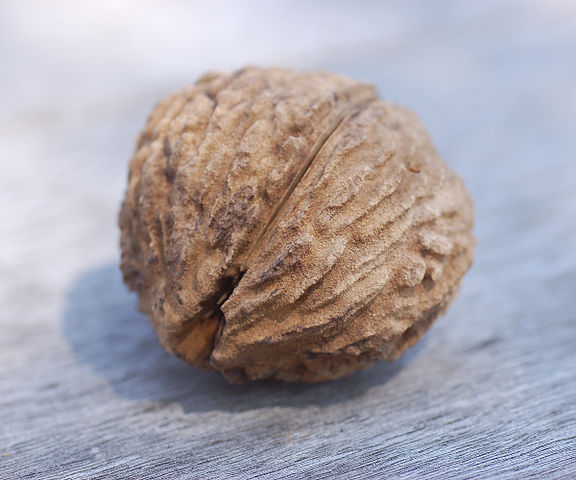
Derek Ramsey, Wikimedia Commons

My brother and I loved playing in the backyard of our childhood home, back in the days when kids enjoyed the outdoors. Probably the single most irksome thing about our wonderland was Mrs. Modell’s black walnut tree hanging overhead. The tree was huge and jutted across a third of our yard. It wasn’t so much the tree we hated, but those troublesome walnuts.

Throughout spring and summer the tree grows its fruit, or the nut and seed. The nut at this stage is encased in a lime green husk that’s hard as a baseball. They gradually grow larger and resemble clusters of lemons or green apples. When they fell early (or we knocked them from the tree), we learned to let them alone because they left a foul scent on our hands.

Auntie G, Flickr
Auntie G, Flickr

In autumn the husk softens as it ripens and then falls to the ground. This is when the backyard became a little less enjoyable for us, for a number of reasons. The old car that sat under the tree made sure we always knew when the husks fell…every single time. Then, they rot and change from greenish-yellow in color to dark brown or black; and the liquefied mush stains anything it touches. Inside that mess is a tough, corrugated nut that looks like a round sea coral.

My brother and I usually didn’t take the time to clear away the husks before mowing the yard, so whole or sharp pieces of nut were always a threat to our bare feet as we ran about. It was only when we became teens that we began to harvest the nuts for our mom and her friends. Drying out and removing the rotted husks required patience unless we were prepared to dive in and get dirty.

O, Taste and See!

That memory causes me to reflect on Philippians 3:14: “I press on toward the goal for the prize of the upward call of God in Christ Jesus”—not in the sense of any effort I put into harvesting those nuts. Instead, I notice the parallel of the subject: the goal…here the nut and fruit of the tree.
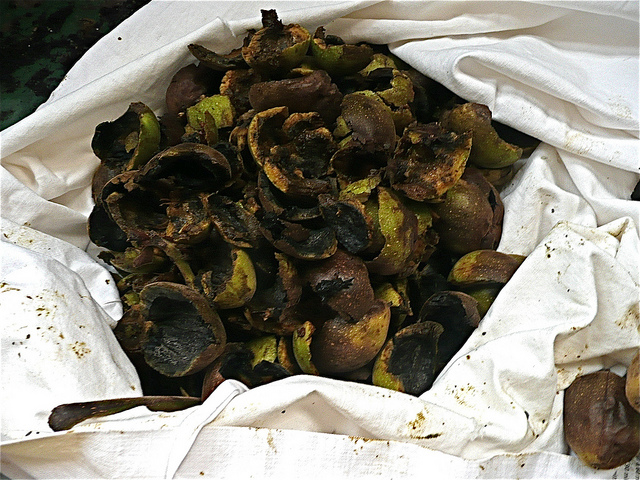
AnnaKika, Flickr
Removed husks AnnaKika, Flickr

My brother and I learned that there was a useful and tasty goodness within those husks that made all that seasonal drama worthwhile, albeit in our yard and not on a farm. It was why the squirrels waited patiently as the seed ripened.

Similarly, living our lives with Christ in mind is like putting up with the annoying and unpleasant aspects of those husks knowing that something wonderful abides. Jesus compares the kingdom to a man who discovers treasure in a field, hides it again, and then quickly buys the field (Matt. 13:44). That field may have been the most miserable boondocks to him until then; but finding that treasure changed everything.

The anthem “Shout to the Lord” ends with a great affirmation: “Nothing compares to the promise I have in you.” Do you believe that? That’s where I stand. Christ is all the world to me—even if it means muck, stinky hands, and the constant thud of husks hitting the ground.

Faith in Clutch Moments

Geoffrey Fairchild, Flickr

“If we are thrown into the blazing furnace, the God we serve is able to deliver us from it…But even if he does not…we will not serve your gods.”

A few months into my work at a fast food restaurant, I sauntered in for my evening shift. The place was quiet and the manager stood at the register and greeted me as I entered the service area.

“Mike, you missed all the fun last night.”

“Oh, really,” I replied.

“We got robbed last night,” he said.

“Yeah, right.” I passed it off as a joke, but he was serious.

This store was two years old and sat on a state highway in a suburban area. Still, that meant little in the scenario he proceeded to explain. My co-worker Richard who first encountered the robber relayed the following account.

Beginning his nightly breakdown and cleaning routine at 9 p.m., an hour before closing, with no customers in the store, a man entered, drew a gun three inches to his face, and ordered him and all other staff to the back. There he made them lie in the floor on their stomachs in an enclosed area while he and the shift manager went to the safe. He left with $1,500 without harming anyone.

Alarmed by the details, I felt sorry for the people who had experienced the ordeal, some of whom were traumatized. It scared me to think of the outcome being any different. The robber was never caught.

Just, Why?

Obviously, I’m grateful I hadn’t been working. Would the situation have been worse if another set of people were present?

Why does God allow such things? Why doesn’t he clearly intervene in crisis…manifest in some way? It’s his world, after all. I think of super-scale natural disasters and heinous moral evils—where is God? These are tough questions to which there are no answers and the Bible offers none.

One of my favorite pastors whimsically asks, “If God is so powerful and good, why doesn’t he just erase the Devil?” I think we all can agree.

Playing with Fire

The topic makes me consider Shadrach, Meshach, and Abednego, who boldly confronted evil in their uniquely dicey situation. For it’s one thing for misfortune and tragedy to strike and overcome you; it’s another thing to have a choice in your fate, which can be much more difficult. “God, I’ll trust you”—because I have no other choice is easier than “God, I’ll trust you”—when I do.

Yet the ‘Hebrew Boys’’ resolve convinces me that questioning, the struggle to understand why, is limited to its ability to make us feel our experience and to induce personal growth and, hopefully, deep faith in God. And that role should not be underestimated. Deep inquiry can even provoke change; however, it just won’t ever halt wickedness. Nebuchadnezzar will have his way.

So evil in the world will continue, yet God remains sovereign and providentially good to humankind. On that basis alone he is to be trusted. God rescues all, the believer and non-believer. I’m so thankful he protected my co-workers. And although only he can fully explain why, I doubt those answers outweigh our rest in his abiding care for us. We wouldn’t understand if he did explain.

In the end, why questions must give way to how questions that confront us about our response. Otherwise, we won’t emerge from fear or pain to wholesome life. Circumstances often don’t change but we must.

{Too, let us praise God for all the ways he does deliver that we never see! There could be far more hardship in the world.}

What Job’s Friends Did Right

"Job's Friends" by James Tissot (CC-PD)
“Job’s Friends” by James Tissot (CC-PD)

Once word spread about Job’s tragic misfortune, three of his friends—Eliphaz, Bildad, and Zophar—traveled to visit and mourn with him. Generally, nothing wonderful is made of these men due to the flawed counsel they offered Job. But their companionship is something they model that we should emulate.

The Pervasiveness of Trouble

Hard times hit us all…no one is immune. Sometimes trouble comes crashing in on us unexpectedly; at other times we bring it upon ourselves. Whatever the case, the toll on a person can be significant in every way.

Job didn’t have just a single problem that stressed him; instead, he dealt with compounding heartaches—financial ruin, the tragic deaths of his children, a hideous and disfiguring disease, and the loss of a supporting wife. We need not wonder about the toll it took on him because he tells us: “May the day of my birth perish and the night that said, ‘A boy is conceived!’…may it turn to darkness” (3:3-4).

How to Help Others

Fortunately, Job had people who cared enough to come see about him, folk who let him know that he didn’t have to face his cares alone. And thousands of years later, the necessity of a ‘crying shoulder’ or person to lean on hasn’t changed. No matter how spiritual we may be or how much faith we possess, we have limitations and will experience emotional pain. But hardship is eased by meaningful relationship.

Here are some pointers I’ve learned helping others and needing that help.

  • Don’t be silent. In high school I had a friend whose mother was killed in a car accident. I never spoke to him about the situation, although I really wanted to but didn’t know how. The problem with silence is…it’s so loud. It becomes the evidence that everything is known, but for some reason you’re not acting; and then it becomes stigmatizing. It shames the one who is hurting, the one who wants to be heard and have his burden shared. Find a way to show care, even if it seems awkward at first. You’ll find your feet as you go.
  • Don’t pity people. Pity makes us feel sorry for folk and glad that we don’t have to live as they do. It is love from a distance, which is no love at all; and it keeps us from feeling people’s pain. Pity disgraces people and makes them feel bad about themselves. It is not the love of God, and it restrains us from getting involved.
  • Don’t turn people into their trouble. Regardless of an individual’s predicament or how they got into it, they are still persons whom God loves and those he requires us to love. If we’re not careful our moral stances can make us calloused toward folk we identify as offenders. But people are not their problems and they can change. If we don’t believe this, then we don’t have authentic Christian faith.

Read more: Helping Others Grieve

What Our Failure Achieves

"Peter's Betrayal" by Carl Bloch, Frederiksborg Palace, Copenhagen (Domain)
“Peter’s Betrayal” by Carl Bloch Frederiksborg Palace, Copenhagen (Domain)

Peter is as real as it gets in the Bible. He is the combination of a gritty human earthiness and wide-eyed love for Christ. I could write a small book on the lessons he teaches me; for now I’ll settle for a significant moment between him and Jesus.

All of You

Having just eaten their last meal with Jesus, the disciples clash about who might be the greatest among them. Jesus interposes and redefines greatness based on service. Then, he addresses Peter in a telling way that settles the matter about his spiritual eminence among the disciples.

31 Simon, Simon! Indeed, Satan has asked for you, that he may sift you as wheat. 32 But I have prayed for you, that your faith should not fail; and when you have returned to Me, strengthen your brethren. (Luke 22:31-32, NKJV)

We don’t notice why these verses are more significant than how we usually read them unless we study them closely. The word “you” in verse 31 is plural and would be a second-person plural pronoun in English, as in “you (all)”; however, “you” is singular in verse 32. Reread it; the interpretational revision is striking. Some versions, like the NIV and NLT, properly reflect this.

Thus, addressing Peter, the most seasoned disciple in age and piety, Jesus explains that Satan had plans to destroy the faith of all the disciples. Then, based on his foreknowledge of Peter’s disgrace (vs. 33-34), he directly challenges Peter—“when you are restored…” He charges Peter with a responsibility for the rest of the disciples.

Satan’s maneuvers had not been limited to Judas; and noticing in Peter some proneness to fall, he demanded him of Jesus, like with Job. If Satan could get the one disciple with the most gleaming faith, he could ruin the whole band. After all, Peter was the one who dared walk on water; the one who confessed the deity of Christ; and the one who jetted from his boat and swam ashore to the resurrected Jesus.

A Charge to Keep

There are many lessons these verses offer, but I’ll select only three.

  • We should see worth in people despite their failings. Jesus goes on to tell Peter in no uncertain terms that he would deny him. Yet he had just implied that Peter’s faith wouldn’t be shattered. Just because people fall into sin or commit a serious offense or crime doesn’t mean they should be written-off. They still bear tremendous value, even greatness. But it will never be realized if after carrying the weight of their misdeed, we gracelessly finish them off.
  • We should pray for those with influence. We know that we should pray for officials and titled leadership. But we should also strategically pray for the salvation of those with significant influence on the minds of others—key business people, celebrities, professors, drug dealers, gang leaders, well-liked family and friends. How many have been saved because Saul became Paul? We thank God that C.S. Lewis didn’t remain an atheist. I think you get the point.
  • Our failures should make us empathetic enough to help others. What we learn about God and ourselves through failing becomes our ministry to others. In other accounts of this very conversation, Jesus tells the disciples that they all would desert him; however, Peter would dissociate himself entirely from Jesus to save himself. Out of that sore experience—because it hurt Peter to his heart—he was to rebuild the faith of his brothers. The Book of Acts and legend of Peter’s death prove that he did.

The Usefulness of Pain

CC BY-NC, Alex Abian, Flickr

“If I had only listened…” Sometimes that’s the saddest statement to hear, especially when disease is involved. Men particularly have a tendency to avoid doctors and linger with health issues. It is crushing when I learn that so-and-so now has prostate cancer or some serious malady that probably wouldn’t be if precaution had been taken when the symptoms first surfaced.

In the final portion of the quote I’ve raised, Augustine uses bodily health to express the utility of pain:

But evils without pain are worse: for it is worse to rejoice iniquity than to bewail corruption…in a body, a wound with pain is better than painless putrescence.

My Painless Evil

“Health is wealth” is a worthy saying. I think all of us would trade riches for a well body. Yet when sickness does come, pain serves a real purpose for the body. Already we mentioned the idea of good and bad pain, bad pain stemming from a less than good or malicious source working against the good.

Augustine now suggests the notion of evil without pain, which is rich in a spiritual context but won’t be dealt with here except to advance his illustration. Doctors can quickly acknowledge the truth of this, and so can I.

I have hypertension, which I discovered in my 20’s. Interestingly, I was home from college on Christmas break and suffered a painful neck injury during horseplay. At that time of my life I was really fit and active; and although some family members dealt with hypertension, it made little sense to me that I should suffer with it. I was too young and doing the right things.

That “silent killer” was an evil without pain in my body. Yet Augustine posits that it is worse to go about dying unawares than to grieve over a bad diagnosis. After all, some people never discover their hypertension because it kills them first. I can be thankful that I learned of my condition.

The God Who Controls All

Instead, says Augustine, “a wound with pain is better” because one without it is too risky. Moreover, although the source of pain may not be good, the pain may be of immeasurable value, one reason Augustine refuses to classify it as evil. The (bad, evil) pain stemming from disease is an alert, which is a good thing; and we cannot deny that the body is designed to facilitate pain and other dangers our senses should indicate.

CC BY-NC, Piers Nye, Flickr
CC BY-NC, Piers Nye Flickr

Certainly pain should be avoided if possible. I cannot believe that God created life with pain in his purpose for it. But although life allows for the possibility of it, pain does not exist without usefulness. Even the pain of the soul and relationships are critical indicators of complications to be healed.

Gratefully, God being sovereign has a design for all evil and pain and that only demonstrates his profound wisdom and glory.

It should give us great comfort that our personal pain is seen and felt by the Lord. It is never wasted of purpose. We cannot always perceive God’s purpose, but we can be sure that all our involvements hold purpose in his hands. This is also why he tells us to do good despite evil individuals and mistreatment. It’s because he backs the good; and as the landowner in Matthew 20:7 says, so declares the Lord—“Whatever is right, I will pay.”

The New Testament is correct in explaining that perseverance is born of faith. When we possess an assurance that God has a purpose and design with our most hateful experiences, we will endure them better.

More in the series: On Goodness and Pain and The God of All Purpose

The God of All Purpose

Moore Tornado, May 20, 2013 CC BY-NC, US Air Force, Flickr
Moore Tornado, May 20, 2013
CC BY-NC, US Air Force, Flickr

Previously we gathered from Augustine the idea that pain generally intrudes where conditions are prime. In his next words he delves deeper into the nature of pain:

But when a being is compelled to something better, the pain is useful, when to something worse, it is useless. Therefore in the case of the mind, the will resisting a greater power causes pain; in the case of the body, sensation resisting a more powerful body causes pain.

Augustine’s acumen here is to distance pain from being classed as something entirely evil. Instead, he implies that it takes on the character of its source. But before I deal with that, some perspective is in order.

Do All Things Bear Purpose?

We’ve already had it explained that nature and being is good because its Creator is good. But what is evil and sin? The biblical definition is plethora involving several words and concepts. Augustine offers the idea of a diminution or privation of goodness and the corruption of what is good (Ch. 4).

Since all things were created good—and evil is not a created thing—then less goodness, a lack of it, or its corruption are verily evil. Evil is always a potential with the existence of good the way darkness depends on the actuality of light.

A takeaway is the question of purpose. Years ago I watched a talk show and the question came up concerning autism—“Is there a purpose for everything, including disease?” Everyone nodded in agreement that there must be some purpose for it.

I couldn’t believe that based on what I knew of the scriptures. Disease (a natural evil as opposed to a moral one) holds no goodness, nor does it bear essential value. Regarding this in a post entitled “Help My Unbelief”, I wrote:

“I am not sure all things have purpose and moral value, and some things, like disease, may exist in a state of failed purpose…to assert that all things do indeed have purpose, from my Christian standpoint, may be leading to the justification of evil and sin’s existence in the world…although some things are mysterious and without apparent purpose, and perhaps consequently evil and used (by Satan) with evil intent, they can be used purposefully, but only if one possesses the power to cause it.”

Good Pain and Bad Pain

Flickr Moore Tornado 2That last line lands us here, squarely in Augustine’s logic. If God doesn’t create evil, he certainly doesn’t create pain. That is not to equate the two, nor is it to say good things may not result from pain, like courage or charitableness.

“But when a being is compelled to something better, the pain is useful, when to something worse, it is useless.” Rather than calling pain evil, Augustine suggests a “symptomatic” approach whereby pain is the result of an opposition between good and less good entities. Pain can be good pain or bad pain.

A body festering with disease and racked with pain is bad pain. Killer germs seek to take control of a healthy body. The agony of running a marathon or weightlifting is good pain. Although the vigorous exercise causes the lungs and muscles to burn, it enhances the body’s overall health. The examples continue and nicely apply to spiritual things.

God, the Great Weaver

Now if we ended here, we’d have evil on the loose, a loophole with purpose, and many tough questions. But preceding all created good and ensuing evil is God, who is the Guarantor of all experiences, good and bad, for those who believe.

“Only God has the power to use all things in purpose,” I conclude—all sorrow, disappointment, disease, and loss, in a plan well beyond our comprehension. Augustine agrees (Ch. 37):

“If anyone should wish to misuse these good things, not even thus does he vanquish the will of God, who knows how to order righteously even the unrighteous…he through the righteousness of his power may use their evil deeds rightly.”

More in the series: On Goodness and Pain and The Usefulness of Pain

On Goodness and Pain

CC BY-NC-ND, Robbie Veldwijk, Flickr

Today marks the first of three days unfolding Augustine’s Chapter 20 of “Concerning the Nature of Good” in his Against the Manichaeans. It is but a single, large paragraph; but as classic literature tends to be, it is replete with thought. So I will explore it in parts and here is the first:

But pain which some suppose to be in a special manner an evil, whether it be in mind or in body, cannot exist except in good natures. For the very fact of resistance in any being leading to pain, involves a refusal not to be what it was, because it was something good.

Recently, I wrote a post entitled “Counting the Cost” about the possibility of dying for faith in Christ. My life having never been in jeopardy for the gospel, I explained that only the day could reveal whether I would stand for Christ or save myself: “Making bold promises from the quiet of my home and a decision about God while staring down an assault rifle is a world of difference psychologically.”

I use that to highlight the idea running through the quote above, especially the second line. (Take a second and reread it.) Every living thing fights to live because living, reproducing, and thriving is what it is designed to do. We say ‘death is a natural part of life’, but really by design it’s not.

CC BY-NC, William Burkhardt, Flickr

Again, we defend ourselves and defend the defenseless according to the same rationale. We possess an internal, God-given instinct for our own physical-mental-social well-being and understand that to be every person’s right. And we’ve long contended for wholesome, traditional values the same way. (So don’t trust the relativists—or go punch one in the face and then tell him it was the right thing for you to do. See just how relativist he is.)

Therefore, it would be awfully tough, in a situation where my life is on the line, to override what is the natural and instinctive thing to do, which is to save myself. Foundational to that notion is the inherent worth and goodness of what is being threatened. Thus, pain has resulted for “a refusal not to be what it was, because it was something good.”

Reassessing the Value of Pain

I encourage you to read “Concerning the Nature of Good” and to learn more about Manichaeism. If you’ve read Confessions, then you are familiar with the religion and know that Augustine was once a Manichaean. In this work he strongly refutes its doctrine.

A main premise Augustine uses is this: Everything proceeds from God who is essentially good and he only creates what is good. Ergo, all nature, he says, is “naturally good” because it is God’s handiwork.

Augustine asserts, “But pain…cannot exist except in good natures.” It’s a striking thought. If you didn’t get it, pain only intrudes where conditions have been prime. This will be developed more in the next post; however, the concept forces us to reevaluate how we view pain.

As he notes, some people see pain as evil. Yet doctors would certainly disagree, and doesn’t God permit pain in our lives? So if pain isn’t necessarily an evil, we are forced to consider its facility in other ways: perhaps as a tool to fashion; as an indicator of desire, strength, or resolve; or as consequence in a cause/effect scenario.

More in the series: The God of All Purpose and The Usefulness of Pain

Acting Against Your Better Judgment

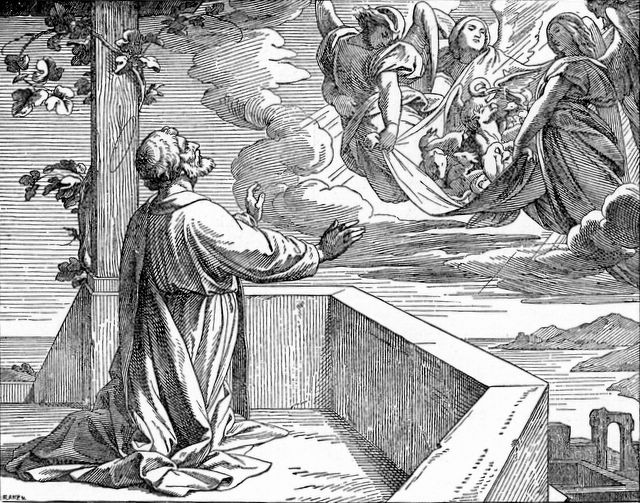
Peter's Vision by Henry Davenport Northrop, 1894 (Domain) Wikimedia Commons
Peter’s Vision by Henry Davenport Northrop
Wikimedia Commons (Domain)

I enjoy provocative dialogue. The topic and interlocutor don’t matter; if it’s exploring theory and ideas, I’m in. What I like even more is leading those conversations and debates and challenging people to consider various aspects of the subject regardless of their stance on it. It forces people to think more broadly and engage where they otherwise would not.

That’s how our minds grow. For instance, most people don’t like reading dictionaries and encyclopedias, something I enjoy doing. But they would be hard-pressed to take away nothing from doing so; learning is the point of those books. Further, building vocabulary and adding new information extends one’s range with language, knowledge, and, importantly, concepts and boosts intelligence. Yet what we’re not exposed to can never be understood.

“That’s How I See It—Next Point!”

Clearly, I like discussing the Bible and faith matters. I recall an exchange between some persons in which I presented Pauline injunctions in the Pastorals regarding church order. I asked for their assessment and opinions of Paul’s instructions for contemporary church life. I quickly noticed something peculiar. They were adamant, even defensive, about their interpretation and application of Paul’s admonitions.

The conversation was surprisingly difficult. I found myself struggling to make these people think deeper and address other implications. Trying to be a good interrogator, I fought to keep back my own opinions from being too quickly apparent; but that failed because the messenger was getting shot! I was saddened that we ended frustrated over the scriptures, but I also hated the fact that they didn’t allow themselves to think from all angles about the topic. Instead, they looked at it and sized it up too quickly.

I was disturbed about their attitude on many levels: How will one relate well with people in an increasingly pluralistic society? To what degree do you expect your own opinions and beliefs to be respected? Are there things that you could be missing? And when it comes to God and spiritual things, what happens when God leads us out of our comfort zones and against our personal rules? Intransigence, or being uncompromising, can render a person incapable of being led by the Spirit. They will close themselves off from illumination and the Spirit’s impressions on the heart.

It is no less a form of being unteachable and fleshly. Consider it: when God puts it in one’s heart or mind to act in a certain manner, to assist one or speak something to another, that person might think to do it but will fight it or justify an excuse to act contrary to what he heard from the Lord; and that’s all because we know what we know and don’t sway from our position.

A Vision Worth Remembering

Peter’s dramatic vision of the sheet of unclean animals (Acts 10) is a worthy reminder that we probably shouldn’t be too quickly set in our ways and close-minded when there are other viewpoints and options. The vision is really interesting because God corrects Peter on the revelation of grace to the Gentiles, to whom one might assume God was calling Peter. Instead, Peter was called to the Jews (cf. Gal. 2:7-9).

It’s important to God to get our general thinking straight and speaks to the personal constitution he expects of his people, indeed humankind.

In my post entitled “Rogue Conviction” I write, “Perhaps a belief is to be possessed or espoused, not vice versa, lest believers (in anything) risk being driven by their beliefs and so become fanatics. People who sacrifice themselves to their convictions often become instruments of those ideas to beat others into subjection.”

You know, this is the attitude that put Christ to death, and it is critical for us Christians to get it right.

Beware Satan and His Crooked Hoss!

CC BY, Todd McCann, Flickr

One day years ago I had to pick my mom up from work. Never tardy, I started arriving early just to read or listen to the radio. The parking lot was always too full for my liking, so I would park in the grass on the quiet road in front of the facility until I saw workers exiting.

This day I parked perhaps a car length behind a trailer truck; it seemed to have warded off the other cars that usually lined up there. I thought nothing of it and relaxed listening to the radio. What came next, however, shot me straight into a panic. The truck suddenly reversed giving me little time to react. I went to start the car to back up but only managed to blow the horn trying to get the driver’s attention. Didn’t he see me?

Not at all—the truck hit the car and started pushing it…and pushing. I kept calm, still on the horn, but grew alarmed unsure if there was a driver in the truck at all or if the car and I would end in the gully feet to the right, crushed.

Fortunately, it was over in seconds. The truck stopped and then pulled onto the road. The driver never knew I was there.

Satan Goes About…Don’t Go to Him! 

I could make arguments about how the trucker should have seen or heard me, but the problem was quite simple: I shouldn’t have parked behind the truck. Or, since there was no place to park in front of the semi, I should have given more space between us and made sure I was in the driver’s view.

In the end, I had badly positioned myself.

That’s something I don’t want to do in life. Who prepares to fail or places themselves in a position to be rescued? Honestly, I don’t think anyone does, even the people who never see how their habitual God-awful choices precipitate their undoing. Moreover, this is the whole reason why people get degrees and retraining and become proactive about their health or parenting. The consequences of bad positioning can be costly.

God tells us the same thing (Rom. 12:21): “Do not be overcome by evil, but overcome evil with good.” Said another way, Satan’s drives that big rig—and he saw you park behind him. Get anywhere near him and he’ll find a way to run you over.

And there’s the point, robed in church bells and angel voices: don’t go near him.