Today marks the first of three days unfolding Augustine’s Chapter 20 of “Concerning the Nature of Good” in his Against the Manichaeans. It is but a single, large paragraph; but as classic literature tends to be, it is replete with thought. So I will explore it in parts and here is the first:
But pain which some suppose to be in a special manner an evil, whether it be in mind or in body, cannot exist except in good natures. For the very fact of resistance in any being leading to pain, involves a refusal not to be what it was, because it was something good.
Recently, I wrote a post entitled “Counting the Cost” about the possibility of dying for faith in Christ. My life having never been in jeopardy for the gospel, I explained that only the day could reveal whether I would stand for Christ or save myself: “Making bold promises from the quiet of my home and a decision about God while staring down an assault rifle is a world of difference psychologically.”
I use that to highlight the idea running through the quote above, especially the second line. (Take a second and reread it.) Every living thing fights to live because living, reproducing, and thriving is what it is designed to do. We say ‘death is a natural part of life’, but really by design it’s not.
CC BY-NC, William Burkhardt, Flickr
Again, we defend ourselves and defend the defenseless according to the same rationale. We possess an internal, God-given instinct for our own physical-mental-social well-being and understand that to be every person’s right. And we’ve long contended for wholesome, traditional values the same way. (So don’t trust the relativists—or go punch one in the face and then tell him it was the right thing for you to do. See just how relativist he is.)
Therefore, it would be awfully tough, in a situation where my life is on the line, to override what is the natural and instinctive thing to do, which is to save myself. Foundational to that notion is the inherent worth and goodness of what is being threatened. Thus, pain has resulted for “a refusal not to be what it was, because it was something good.”
Reassessing the Value of Pain
I encourage you to read “Concerning the Nature of Good” and to learn more about Manichaeism. If you’ve read Confessions, then you are familiar with the religion and know that Augustine was once a Manichaean. In this work he strongly refutes its doctrine.
A main premise Augustine uses is this: Everything proceeds from God who is essentially good and he only creates what is good. Ergo, all nature, he says, is “naturally good” because it is God’s handiwork.
Augustine asserts, “But pain…cannot exist except in good natures.” It’s a striking thought. If you didn’t get it, pain only intrudes where conditions have been prime. This will be developed more in the next post; however, the concept forces us to reevaluate how we view pain.
As he notes, some people see pain as evil. Yet doctors would certainly disagree, and doesn’t God permit pain in our lives? So if pain isn’t necessarily an evil, we are forced to consider its facility in other ways: perhaps as a tool to fashion; as an indicator of desire, strength, or resolve; or as consequence in a cause/effect scenario.
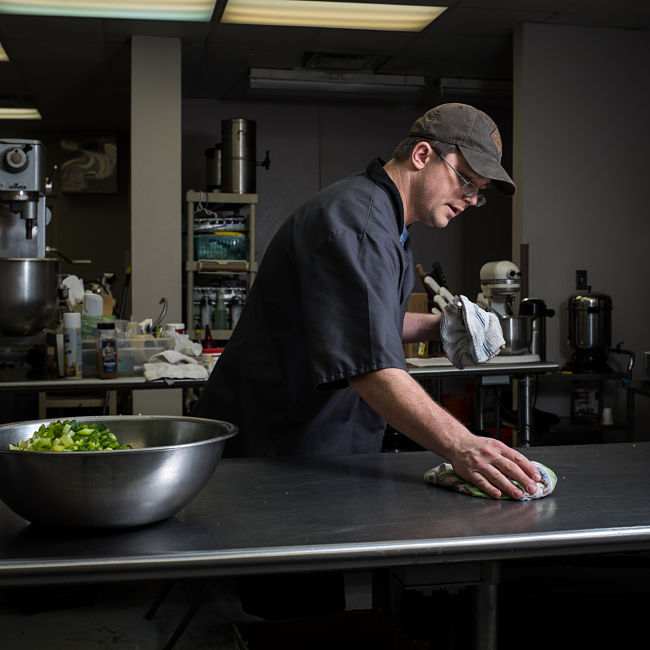
Ted Luoma is writer of cateritforward and a volunteer chef withMercy Chefs, a nonprofit disaster relief organization. Here he shares his experienceswith Mercy Chefs. (Photos by Ted Luoma)
What is Mercy Chefs?
Mercy Chefs is a nonprofit organization that serves people restaurant-quality meals in disaster areas. All staff—from the CEO to the dishwashers—is volunteers. Nobody receives a salary and Mercy Chefs relies 100 percent on donations.
Are you a chef?
Not even close! Mercy Chefs appeals to me because I get to rub elbows with real chefs. I have no training. My chef friends give me direction to hone my skills, and they treat me as an equal. At best, I would consider myself an apprentice.
What made you learn how to cook?
I began teaching myself how to cook about a week after I met my wife 17 years ago. She invited me over for dinner, and I was treated to a hearty plate of Hamburger Helper. Now, I’m not knocking Hamburger Helper, nor am I denigrating my lovely wife; but cooking for someone is very intimate. You expend your love and creativity to create something to please and comfort others. I realized that I wanted more in life than meat slop.
Where have you served with Mercy Chefs?
In Vilonia, AR
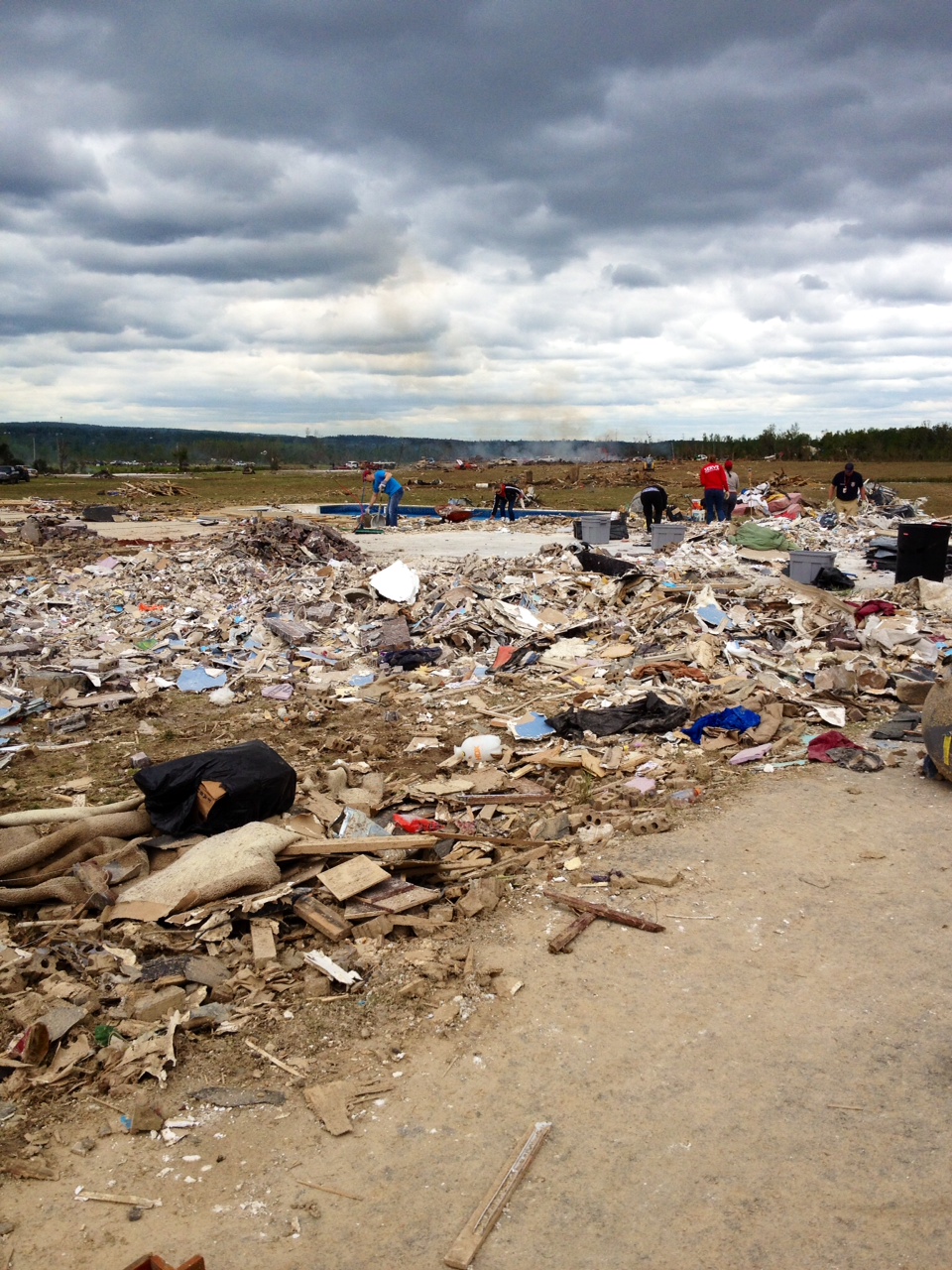
I served two weeks in Chambrun, Haiti. I served in LaPlace and Kenner, Louisiana, in response to Hurricane Isaac. Numerous tornadoes hit the Oklahoma City area last year, and we served in Moore as a result. I spent a couple of days in West, Texas, after the fertilizer plant explosion. The Red Cross actually chased us off. I guess they wanted to be in the spotlight since President Obama came to visit. I just returned from Vilonia, Arkansas, where a half-mile wide tornado ravaged the area. We were immensely blessed on that trip. One business gave us 60 pounds of live crawfish.
What is a typical deployment like?
There is nothing typical on these trips. There is a lot of hard work and you generally work from 5:30 a.m. to about 10 p.m. I buy my own gas to drive to the disaster site. Sometimes we stay at hotels, but normally a church will make room for us.
What was your most memorable deployment?
Greeley, Colorado. I met Chef John in Dallas and we jumped in the truck and began towing Mercy 1, the very first kitchen trailer. It is a 37-foot trailer complete with a six-burner range, tilt skillet, commercial sink, two convection ovens, and all the cookware required to feed an army.
It was my turn at the wheel. As we passed through Amarillo, Texas, the fuel gauge showed we only had about a quarter-tank. John and I decided that we had enough diesel to get some more miles behind us before we stopped. The motor acted up periodically and I sniffed something that faintly smelled like burning antifreeze. A quick check of the gauges revealed nothing; we didn’t have much choice but to press on.
In Kenner, LA
We rolled into Dumas, Texas, on nothing but fumes. As I began turning into a truck stop, steam began to rise from the hood. I was caught off-guard and cut the wheel too sharp. I took out the trash cans next to a gas pump with our mobile kitchen. I could barely contain my laughter. I finally brought our rig to a stop next to the fuel pump. Antifreeze had drained all over the ground and it appeared we were in trouble.
This was a Sunday evening and we were surprised to find a mechanic to investigate. The radiator was shot and one had to be ordered from Amarillo. Our only option was to hole up at the Quality Inn and wait—for two days. The rest of the trip was pretty uneventful—except for the blowout on the trailer after we left Colorado. We learned a valuable lesson on that journey: Dumas is a glorified truck stop. We will not go back…too many radiator memories.
Aside from Mercy Chefs, what do you do?
In a word: housewife. At least that’s what I tell people when they ask that question. I do the cooking; as for the cleaning, not so much. There is the catering thing, too.
Have you always volunteered?
I never wasted my time thinking about others before my conversion. Now a Christian, I’m much more concerned with others than I used to be. I can thank my church for that because it encourages serving.
What is your favorite Bible verse?
John 14:6 is probably my favorite. Jesus Christ sums up his position as “the way, the truth, and the life.” His “club” is very exclusive. It’s nice to have that clarity in a postmodern age in which there are many truths.
Have you ever had a job besides cooking that you enjoyed?
I was a disc jockey for 12 years. I’m not a natural when it comes to radio. It took years of effort to grow into just as it has to be a competent “chef.” I could have worked in a major market, but radio isn’t conducive to having a stable family. The thought of moving every couple of years wasn’t appealing to my wife. I just put that effort into cooking. I figure I’ll be pretty good after another 10 years of practice.
Who in the scriptures besides Jesus teaches you much, whether about God, spirituality, or your own humanity? (Choose one person and tell us what they teach you.)
The Islamic militant group Boko Haram recently kidnapped hundreds of Christian and Muslim teenage girls in northern Nigeria. Video of nearly half the girls surfaced showing the leader bragging that all had supposedly converted to Islam and been “liberated.”
That’s the part that provokes me—“Michael, what would you do?” Knowing Christ as I do and my love for him, how would I handle the situation when the time came to make a vow to Allah? In no way am I trying to cast aspersion on any of the girls; instead, I’m attempting to place myself inside their horrible experience and explore my own spiritual moorings.
I have never experienced that level of persecution, for anything. So I cannot predict my response with 100 percent certainty. Making bold promises from the quiet of my home and a decision about God while staring down an assault rifle is a world of difference psychologically.
Yet this is why we strengthen ourselves in godly devotion. We prepare for the day of trouble directly aimed at our faith in Christ, not unlike in the early church and for those today in persecuted areas. Hopefully, we keep in mind that our profession might cost us everything, all comforts and our very lives.
Jesus didn’t try to save his life for us, so will we save ours for him?
I just had to share this with you. Here is a live feed of the International Space Station’s Earth Viewing Experiment. The Station orbits the planet at over 17,000 mph—or 5 miles per second!—and experiences a sunrise every 92 minutes. If you see grey, it means the cameras are toggling; and if you see black, […]
I am pleased to introduce my dear friend Melissa Lingard with whom I worked while in Japan. Melissa now serves with Destiny Rescue, a Christian-based non-profit dedicated to rescuing children from human trafficking and sexual exploitation. She is based in Chaing Rai, Thailand.
What is your job at Destiny Rescue and how long have you been doing it?
I am Child Sponsorship Director for Destiny Rescue. I have been working in sponsorship for over six years now.
You and I were co-workers in Japan. I know that you enjoy children. In Japan you taught kids English and worked with children at church. Now you’re rescuing youth from trafficking. Do you feel that you are called to young people in some way?
I definitely believe that I have been called to work with young people. I’ve always loved kids. When I was young, I loved playing with the littler kids and babysitting them when I was older. When I finished high school, I dreamed of working in an orphanage overseas one day or something similar. God put that desire there; I knew way back then that this was the plan he had for me. I have been blessed with an amazing family and have grown up with a loving mum, dad, and two sisters. I always felt loved and protected, supported and encouraged. So one of my burning desires is to show kids who have not had this what true love—the love of God—looks like.
How does a person enter human trafficking and sexual exploitation?
This isn’t a simple question to answer because there are many reasons why a child or teenager may enter trafficking and exploitation. For the sake of brevity, I will use one example, which is the story of many of the girls we have rescued in Thailand.
In quite a few cases we have found that abuse may have started at home by a family member, a friend of the family, or a member of the village or town before the child ever left home. The child feels like she has no worth after being abused and thinks she deserves anything else that happens to her later. In most cases, poverty or large family debts, often incurred through a family member’s gambling, drinking, or drug addiction, means that the family desperately needs money to provide for basic needs or addictions. So a child will be sent to look for a job to help pay off family debts.
Yet with little education and no skills and often no citizenship to make it legal for her to get a job, she is left with little choice but to work illegally in karaoke bars, strip joints, and brothels. Often recruiters go to villages and talk to families, particularly the children, about promising jobs in the city. The kids get excited thinking they can help support their families; but when they arrive at their places of employment, they find out that the recruiters have lied to them.
Once they are there, they often find it hard to get out because the bar owners claim that money is owed to them and that it needs to be worked off, or they take away any ID the child possesses. The girl usually feels trapped and sometimes she is [trapped] physically; but she is always trapped monetarily, if not from the debt the bar owner holds over her, then from the pressure of her family to send money home. Familial loyalty, no matter how misplaced it may be sometimes, is extremely strong in the countries where we work.
What has been your best and worst ministry experience in the field?
The worst experience, by far, is when a girl who has been with us that I have gotten to know chooses to go back into the dark place where she was rescued due to family pressure, low self-worth, or other reasons. My heart aches for her. These girls have been through so many traumas that they are often incapable of making good decisions and have trouble accepting that they have worth.
The best times for me here are our Youth Worship nights on Fridays. All the kids from all of our homes come together for games, music, and loud, all-out, top-of-the lungs singing to God. I cannot express how much I love these nights. To see all these kids, each of them with their own story of brokenness, singing praises to God with huge smiles on their faces. Not all of them have given their hearts to God, but they LOVE to sing his praises. I know this makes God smile so much!
Another “best” is seeing the girls who have graduated from the program starting small businesses and getting jobs and living normal lives again.
Is there anyone in scripture you try to emulate in your work or a biblical scene that spurs you on in your efforts?
I have always been able to relate to Moses. I am not naturally an overly confident person; and, like Moses, I have been known to have conversations with God telling him how I am not equipped to do something. But God has taught me through Moses and my experience that he is the one who gives me the ability to do things.
You speak fluent Japanese and helped me out greatly in Japan. Now you’re learning Thai. Which is tougher: Japanese or Thai?
Thai is definitely more difficult for me. I have been here for six years, longer than I lived in Japan, yet Japanese is still more comfortable for me and more fluent than Thai. But I had studied Japanese before I went to Japan and was immersed in it when I was 18. Also, I used Japanese every day for three years on my job with a Japanese tour company before coming to Thailand
My work here in Thailand consists of much administration done in English. So apart from eating, socializing, and shopping, I don’t use Thai much. One more thing: Thai is a tonal language and Japanese is not, another factor that makes Thai more difficult. You may know the word but if you don’t say it with the right tone, nobody knows what you are saying!
You are from Queensland, Australia. Do you wish to return to Australia and live a more normal life, or is international ministry a lifelong desire for you?
What is normal! While I love my family and my native Australia, I can’t really see myself living there long-term again anytime in the future. I’d never say never, as you can’t know the plans that God has for you and things can change in an instant. But right now I see myself in international ministry for the rest of my life in some capacity. It may not always be in Thailand, but my heart is definitely for the nations.
How do you get away from the stresses of your job?
Massages. Weekends away with the girls. Reading. Watching movies. Hiding out in my house on the weekends. Listening to worship music. Coffee dates. Going home once a year.
Where can readers learn more about trafficking, Destiny Rescue, and donating; and how can people support and pray for leadership and those being rescued?
They can check out our website and blog at DestinyRescue.org and like our Facebook page. Also, our 2020 Vision Campaign is to rescue 100,000 kids from sexual slavery by 2020. To accomplish this leaders need wisdom, guidance in strategy, finances, and the right people in the right places. The harvest is plentiful but the workers are few. Being a volunteer organization, it is not always easy to fill the needed positions. I ask readers to pray that God would guide the leadership in each of these areas and give us volunteers for all the positions needed to fulfil this vision.
What are two things people would be surprised to know about you?
Well I like watching Japanese TV dramas. And I have ridden bareback on an elephant more than once and hugged a tiger.
Fragrance is contextual. Every perfume is not right for every season or occasion. So the conscientious wearer will build a fragrance wardrobe that might include essentials for casual and work times, formal events, sporting, festive occasions like holidays, and warm and cool seasons. The assortment helps one fit the mood or event.
CC BY-NC, CityRover Media, Flickr
Now that’s the more common method of fragrance wardrobing. Another technique is to layer the body with the same scent. Thus, a person will use a body scrub and a body lotion in the same fragrance; then finish with a light spray of the perfume or cologne. This ensures that the fragrance lasts the entire day.
A third and less common way is to use different scents at the same time to create a customized fragrance. But since this is an easy way to unintentionally make yourself stinky and talked about, I’ll stick to one scent and leave the mixing to the perfumers!
Something Old, Something New
Wardrobing is a rich illustration of the way God has stocked our lives with talents, experiences, ingenuity, wisdom, and an array of elements, including the power of the Spirit, to match any occasion in which we find ourselves.
Two scripture passages convey the wardrobing concept to me. First, Peter marvelously explains, “His divine power has given us everything we need for a godly life” (2 Pet. 1:3); then, he encourages his readers to continually add godly virtues to their faith. “For if you possess these qualities in increasing measure, they will keep you from being ineffective and unproductive in your knowledge of our Lord Jesus Christ.” (v. 8).
CC BY-ND, WCSU Peggy Steward, Flickr
This verse is so versatile with the concept. In the sense of variety, we can view adding goodness, love, and more as maintaining our witness of Christ despite the circumstance. Tempted? Christ smells of self-control. Persecuted? He’s a strong whiff of perseverance. Or, in the sense of layering, we can perceive those virtues, one upon the other, as keeping the scent of Christ strong on us, the scent Paul calls “the pleasing aroma of Christ” (2 Cor. 2:15).
Lastly, I cannot forget Matthew 13:52: “Therefore every teacher of the law who has become a disciple in the kingdom of heaven is like the owner of a house who brings out of his storeroom new treasures as well as old.”
This verse describes the connoisseur and discriminating one who understands propriety and possesses the depth, creativity, and facility to handle any occasion, masterfully so.
This is also Christ in us keen—“I am sending you out like sheep among wolves. Therefore be as shrewd as snakes and as innocent as doves” (Matt. 10:16); “Use worldly wealth to gain friends for yourselves, so that when it is gone, you will be welcomed into eternal dwellings” (Luke 16:9); “When you are invited, take the lowest place, so that when your host comes, he will say to you, ‘Friend, move up to a better place’” (Luke 14:10).
I encourage you to do as Peter advises and wisely make your spiritual fragrance wardrobe as varietal as Christ has made it possible for you. He in his many ways is the scent you spread.




 A 'Mike' for Christ