The Cost of Fine Scent

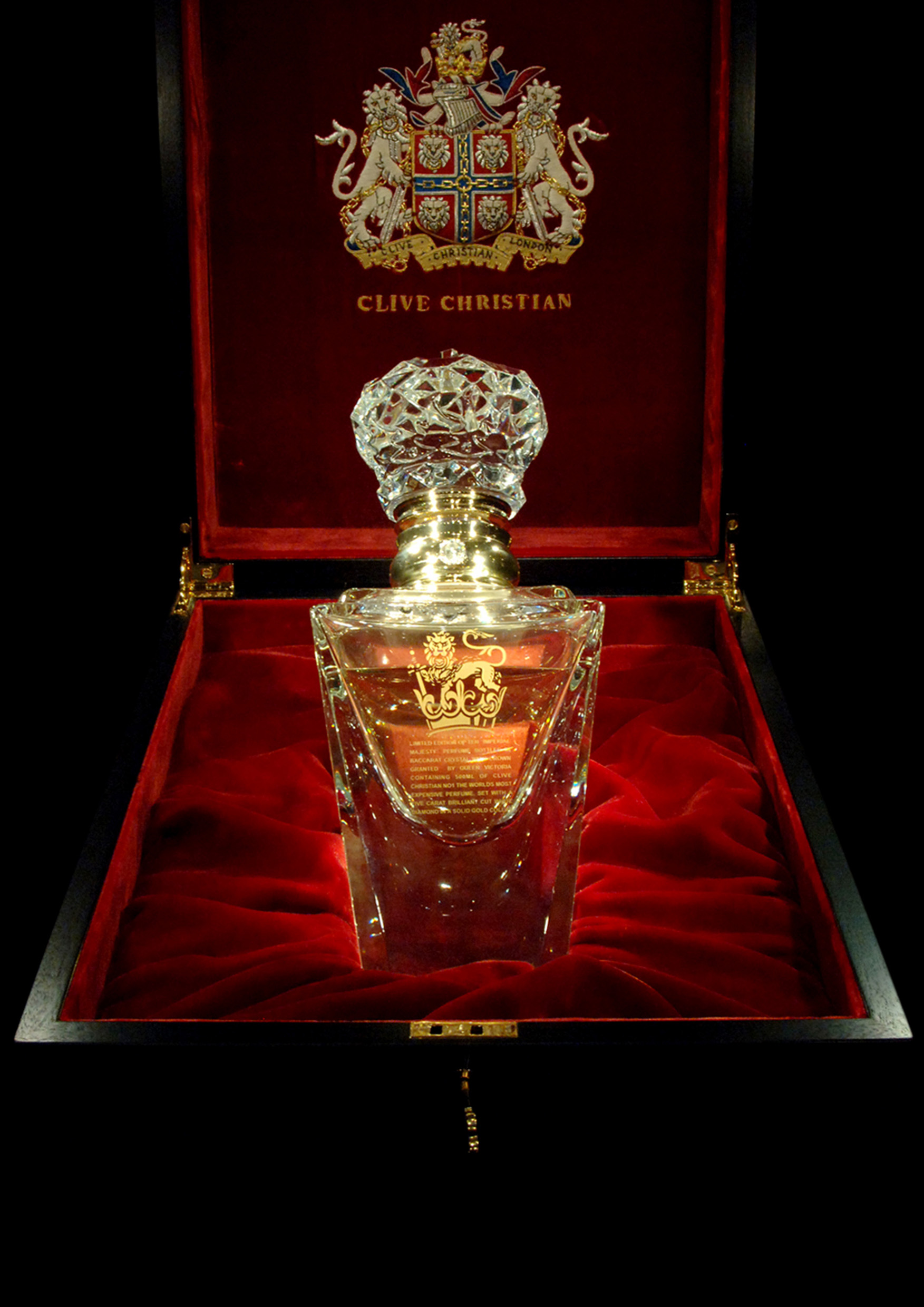
The World's Most Expensive Perfume Cost: $215,000 Credit: GildedLife.com
World’s Costliest Perfume
$215,000
Credit: GildedLife.com

I’d like to share words from GildedLife.com* about the world’s most expensive perfume, Clive Christian No. 1. Read the fascinating excerpt below and then view the minute-long video.

In 1999, famed kitchen and interior designer Clive Christian purchased the London-based “Crown Perfumery” company…As a result, when Christian approached world famous perfumer Roja Dove, he had one criterion: Money is no object.

According to Symrise, Roja Dove “opened his treasure chest – his collection of scents – and looked for the most precious and expensive notes the world has to offer. Rose oil for 6,000 euros, orris root for 11,000 euros per kilo, jasmine from India, Italian cinnamon rose which requires at least 170 blossoms for a single drop of oil!” A batch of this liquid gold reportedly takes six months to reach the perfect stage of spice.

The result was Clive Christian Perfume No. 1. A single ounce, or 30 ml, costs $2,350. And then, there is the magnificent Clive Christian No. 1 Imperial Majesty Edition…

A 500 ml release known as Clive Christian No. 1 – Imperial Majesty will set you back approximately $215,000.  This fantastic edition comes in a French Baccarat crystal flacon.

[T]he bottle is made of, “a material which is so difficult to work with that one of every three attempts breaks during the production process. The neck of the bottle is fashioned after the coronation tiara of the British queen and is made of 18-carat gold inset with a five-carat brilliant-cut diamond. This collar is later engraved with the owner’s name.” This one-of-a-kind bottle is then gently placed into a velvet-lined ebony case with gold and platinum details.

Amazing, eh?

The Price of Our Pain

Two things usually make a perfume expensive, one more legitimate than the other: 1) rare ingredients and 2) marketing. It all has to do with the rarity and quality of ingredients and their ratio in the mix, especially with pure ingredients as opposed to synthetic ones.

I shared the info above about Clive Christian because it so captures how God values our painful experiences.

Pain—who cares for it? Paul begged God three times to release him from a “thorn in the flesh” (2 Cor. 12:7-9). Nobody likes pain and life is rife with it. But God is able to redeem it and allows none of it to be wasted.

People do not always understand what goes into making us who we are. They just know—keeping with our theme—that you “smell good.” They like what they smell because they sense the fragrant oil of the Spirit on you. You’re devout and ministry-minded and anointed (“smeared”); everything seems to be going your way—now. But they rarely understand the cost that makes you…you.

Wasn’t this the case when Mary, Lazarus and Martha’s sister, broke open the alabaster flask and anointed Jesus? The disciples protested the expensive “waste”; however, they didn’t understand the cost of her extravagant worship. Surely, she could have told of her personal pain and the mistakes that brought much of it on her.

Those mightily used by God have oftentimes experienced the greatest pain. The interesting thing, however, is they have usually lost the scent that others admire. Their pain has been a hugely formative experience leaving them focused on their mission. So it can be difficult to comprehend that what hurt them and cost them everything heals others in a marvelous way.

God values that like we value Clive Christian No. 1.

*Credit: Clive Christian Releases the World’s Most Expensive Perfume—Clive Christian No. 1”, July 28, 2010

A Scent of Your Own

CC BY-NC-ND, David Nutter, Flick
CC BY-NC-ND, David Nutter, Flickr

Today begins the first of a 3-day series I call Making Sense of Your Scent. I will draw comparisons between the spiritual graces in our lives and perfume. Also, make sure you watch the video; it’s very interesting.

While on the Champs-Élysées in Paris, I made sure to look for Sephora, the famous French cosmetic chain. I needed to visit because I was searching for cologne I couldn’t find in Japan; but I desired to go there to see their famous fragrance counter.

And there it was—an in-the-round, tiered, organ-like setup with hundreds of “essences.” A fragrance professional stood in the center eager to let shoppers try whatever scents they had in mind. She knew what each sent was, where to find it, and how best to use it.

Making One Smell Good

Perfumes are a combination of alcohol, water, and fragrant oils mixed at certain ratios. There are literally thousands of fragrances, and new ones are being made all the time. None are exactly the same; formulation is a painstaking science. Moreover, the final product is a specific, designed scent the perfumer originally had in mind.

But how a perfume smells on us individually depends on a host of things: skin chemistry, body heat, hormonal changes, diet, medication, stress level, and more. So not only is there a host of components for many different fragrances, there is also a host of conditions that make a particular scent blossom on one person and reek on another.

God’s Fragrance for You

Romans 12:6 explains that each of us possesses different God-given gifts according to the grace granted us to exercise those abilities. This set of gifts in Romans 12:6-8 have often been termed motivational gifts and serve as ministerial tools proceeding from aspects of our personality and character. Although these gifts deal with our temperament, God-given abilities are certainly not limited to those mentioned in scripture.

There are a few important points that should not be overlooked.

  • You have a gift. Call it a gift or talent—I don’t care; but God has placed a special ability, or abilities, in our lives that is our responsibility to strengthen and use for his glory.
  • You should be exercising that gift. We dishonor God by diminishing his graces in us. Let naysayers…neigh-h! But we need to be about God’s business. For when we scratch below the surface of that gift, we’ll discover a natural fitness for it and a personal enjoyment.
  • Never compare yourself to others. It is our responsibility to work the gift; it is God’s responsibility to make it effective. Only you know the level of grace given to you; so it’s not for you to tuck your tail when you perceive someone else with a greater measure of grace in that area. God gives increase and may desire to raise your gift to unimaginable heights. But don’t shortchange him because you feel inferior to someone else.

You see, the graces in our lives are the specific fragrance God has designed for us. It smells good on us because the formulation is suited for our particular makeup. But if you try to wear the fragrance that has been specially-made for me, it just might stink on you!


10 Questions for Mark Myers

This week’s “10 Questions” go to Mark Myers of Life in Portsong. If you’re not familiar with Mark’s fun and folksy style, well what are you waiting for!

Mark, your April Fools’ ploy might be the ultimate ruse with readers. Yet you seem to unintentionally trick people into believing that Portsong is not only a real place but you are its mayor. How great is that for a writer! From where do Virgil Creech and this fictional world derive? 

I’ve been plotting and scheming stories for years. It wasn’t until about five years ago that I sat down and began writing. A mentor of mine by the name Jack Frost—I kid you not—struggled and eventually passed from cancer. He had pushed me to pursue my passion.

The world of Portsong evolved as a story about the old man Colonel Birdwhistle relating to a new environment where he continually crosses paths with some boys he can’t shake. My original intent was to have the colonel be a little bit of a huckster; but I fell in love with his character and changed course.

How seriously do you take your writing? What is your writing process?

I love to write and I take it quite seriously. That said, I can only do it a few hours in the morning because it has yet to pay the bills…even the little water one. I don’t know how to describe my style. I typically chart the story, main theme, and moral I’m trying to display; but I wander like a Beagle after that. Nothing turns out the way I started.

The word humorous will probably be used by most readers to describe you. What’s your take on Mark Myers? Was he ever the humorous son or class clown, or was he altogether different?

Remember that scene from Good Morning, Vietnam where Lieutenant Steve says, “In my heart, I know I’m funny,” but he isn’t? I’m probably that guy. I caused a good deal of trouble as a lad. My report cards bear out that I talked too much and was too stupid to keep from getting caught. I’m told now that I am incredibly immature. My daughters say I act like a seven year-old, which I like.

Many readers may not know that you are a Desert Storm veteran. Have you chronicled your war stories, or do you use writing to process your feelings from that time?

CC BY-NC, Enokson Flickr

My service was anything but distinguished. I love that I was in the Army, but I didn’t always love being in the Army at the time. I had been out for a year when Desert Storm came up and got called back to serve. I never did more than defend the shores of South Carolina. I got orders to go over when the ground war started; but since that only lasted a couple of days, my unit got sent home instead.

You’ve recently shared with readers about your daughter’s serious illness, something many people might choose not to do. Why did you feel you could share that news and how are you dealing with it?

My blog is all about what is going on in my life and my warped take on it. As I say in the “About Me” section, I find humor in most things and God in everything. There is no way I can blog about my life without sharing about the cancer that has forced its way in. There is no manual on how to fight this thing, no playbook. So we are fighting cancer with a smile in our house. If you haven’t checked out her site—smileyforkylie.com—I think you’ll see what I mean. The kid averages about 2,000 hits a day on a two week-old site while I am happy with a fraction of that. (Note: If you’ll recall, Mark is “newly bald” in the video. He cut his hair to support his daughter.)

You live in Georgia and seem to have a good handle on all things Southern. What do you like about the South?

I like the gentility of the South. It’s still here, especially when you go to some of the smaller towns. People tend to have a little more time to speak and acknowledge each other and use manners. Also, being a believer, it’s nice to be in a place where we still have a foothold.

Are you a big reader? Who is your favorite author?

I am a huge reader. I’m the nerd who reads through his lunch. I typically have two to three books going at a time. I love classic English and Russian literature. Charles Dickens is my favorite author; a close second is Leo Tolstoy. And if you go modern, I love the works of Markus Zusak.

Tell us about your publications and where we can find them. Further, what are your writing aspirations? How actively do you query publishers?

I have written five books. Thus far, Virgil Creech Takes a Swipe at Redemption is the only one in publication. I should be releasing the rest of Virgil’s trilogy this year. The others probably aren’t ready.

As for publishers, I have queried agents but not seen success there. But I’m a take charge type of person and don’t mind doing it myself. I like the fact that I have control over what goes into the book. I would love to find my niche with a publisher; however, it hasn’t happened yet…maybe someday.

CC BY-NC, Brandon Flickr
CC BY-NC, Brandon, Flickr

Mark, what does Heaven look like?

Oh! Heaven will be a wonderful place: new colors, [musical] notes, smells…things we can’t even dream of. All of our frailties will fade away, and we will see Jesus and sing his praises for eternity. I’m sold!

What are two things people would be surprised to know about you?

First, I have sung onstage wearing a coconut bra and grass skirt (in the South Pacific). Second, although I consider myself a confident man and am a salesman by trade, I am deathly afraid of car salesmen.

What questions do you have for Mark? 

Read more by Mark at his blog Life in Portsong.

Wow! What a Head!

CC BY, Thomas, Flickr

“Instead, speaking the truth in love, we will grow to become in every respect the mature body of him who is the head, that is, Christ.” (Eph. 4:15)

Who has not admired a newborn or young child and thought, Look at the head on that one! I know I have and I know you have, too. It’s a fact of life: humans, from fetus to toddler, have big heads. And it’s by design.

Babies’ brains grow large in vivo and quickly develop to an advanced stage in order to accommodate the body’s further development. A child’s brain is one-half its adult size by nine months and two-thirds that size by two years of age. Of all species, the human brain is proportionately larger than other animals’. Studies suggest that the larger the brain, thus head, the more intelligent the child.

Interestingly, our brains would be bigger if they could be. The brain is the human organism’s administrative “ground zero,” certainly the most mysterious body part and a science with many vague areas still. Yet all that remarkable circuitry and undiscovered ability is packed into our craniums, its growth limited by one thing: the size of the birth canal.

An infant’s head is never larger than 25 percent of its size; strangely, some still sport a whopper of a noggin!

The Chief Thing

One of the Bible’s metaphors for Christ is “head of the body” (Col. 1:18), signifying his Lordship over the Church. We should think more broadly here. Scripture also refers to him as the “firstborn” of creation (Col. 1:15) and of the dead (1 Cor. 15:20). It all points to Christ’s preeminence, as Hebrews 1 so marvelously explains.

Our English word “capital” derives from a Latin root meaning “of the head.” You’ll recognize the concept in statistical parlance specifying something “per capita” or per person, literally meaning “by the head”. The idea of authority and supremacy are strongly affixed to “head”, which is obvious when “capital” is defined.

In Good Proportion

Paul’s concern in Ephesians 4 is the growth and maturity of the church at Ephesus. You may recall that he spent three years there on his third journey. In his farewell to the elders, Paul offers us a glimpse of the conditions vexing the Ephesian Christians:

“I know that after I leave, savage wolves will come in among you and will not spare the flock. Even from your own number men will arise and distort the truth in order to draw away disciples after them. So be on your guard! Remember that for three years I never stopped warning each of you night and day with tears.” (Acts 20:29-31)

So from prison in Rome, Paul writes to them and, in Ephesians 4, highlights the rich diversity, complexity, instinct, and acumen of the spiritual gifts that flow from Christ, the Head, to the Church, his Body.

And what is the intended result? “Until we all reach unity in the faith and in the knowledge of the Son of God and become mature, attaining to the whole measure of the fullness of Christ” (v. 13)—or until this body catches up with its head; and “no longer be infants, tossed back and forth by the waves, and blown here and there by every wind of teaching and by the cunning and craftiness of people” (vs. 14)—or until we gain the strength and coordination to stand and walk and do so against all resistance.

When we look back at the early church, we see a baby with a mighty big head, wouldn’t you say? Hopefully, today we’re a mature and fit body that matches.

More on this topic: A Survey of Ephesus, Paul and Timothy’s Field

Uri, the Elder Brother

CC BY-NC, Jonathan Cohen, Flickr

Among the best known parables is the story of the lost son. Here I only care to deal with the elder brother. And since that’s how we’ve only known him, let’s personalize the story a little and give both him and his younger brother a name. Uri will be the elder brother and Zev will be the younger one.

The Good Son

The entirety of Luke 15 is Jesus’s response to the Pharisees’ murmuring about his associating with the rotten apples of society. This is important to remember because he implies many things about the Pharisees in the lost son illustration.

As stories go, Uri’s is a little complex and sad. As for any scripture, we cannot make arguments or assumptions from silence, especially with parables; but I wonder some things about Uri. And since parables demand that we think contextually, follow along for a moment.

I am probably correct to assume that Uri loved Zev most of his life. I think he rallied to his father’s side when Zev started rebelling. Uri must have pleaded with his brother to not do something stupid by leaving; he knew Zev possessed a wild streak. Overall, I think Uri was a good son and a good brother.

Still, nobody was able to stop Zev; and for all anyone knew of him in the interim, he very well could have resurfaced with a caravan of riches. But when this wasn’t the case, indeed far from it, the moment revealed the character of Uri’s heart.

A Profile of Uri, the Elder Brother  

Uri was juridical, rule-oriented, and contractual. He colored inside the lines and had learned to do so very well. He deeply appreciated the reason for those lines. They were order and civility and justice that made the world turn.

But he was unyielding about compliance, his own and everyone else’s. Uri colored only in black and white, and he bore little tolerance for transgressors. He believed in swift and immediate reprimand. For him, love was defined in legal terms and breaking the law made one unlovable.

“It’s All Yours, Uri.”

In Uri’s mind, Zev’s departure was an unforgivable split Zev had created. His request for his inheritance was tantamount to wishing his father dead. So now that he’s back after having been beaten by life within an inch of his own, Uri can hardly control his contempt and disowns Zev. His father cannot convince him to join the party he should be co-hosting, not even with the sobering reminder that his brother hasn’t returned dead. But by Uri’s convictions, that would have served Zev right for what he had done.

(Ever met people like this?)

Further, Uri is beside himself that his dad should go to such lengths to welcome Zev back. It cuts him deeply: no hoopla was ever made over him. And he has worked his butt off for his dad. But Uri didn’t understand that he was the only one caring about his performance. His father loved him and owned a proud heart because all he possessed was under Uri’s management and discretion.

The question is how well Uri knows his father; the answer is not well at all.

Uri’s problem in the parable is that he doesn’t have his father’s heart and had never properly assessed his father’s character. Relationally, although he was the elder son, he lived more like a servant, even a foundling or an orphan. He worked for love that was already his. Nothing stopped him from having already hosted several of his own events, but his heart harbored incorrect assumptions about his father that limited his freedom.

The Father: Get to Know Him

Uri’s problem is the same lofty piousness that makes us no longer resemble our Father. Erroneous views about God that have been pushed on us and our own wrong theological conclusions all conflict us and burden what should be a vibrant father-son bond with duty and fear and resentment.

What’s really peculiar is that we’ll go on unaware of our problem until we encounter others in need of God’s love. Our relational deficiency will show itself for what it is: our prepotent need. And like a sputtering car, coughing and choking, we will spew a black smoke of toxins in the faces of those finally ready for fresh air.

Hopefully the Spirit will get us to see how we’ve made it our job to zealously defend and protect God from those who need him most; that we’ve too often forgotten all about the people we should love and opted instead for gracelessness and sanctimony, proving our lack of true religion more than anything.

In the end, let it not be that we have glamorized Jesus and his ministry to outcasts and cared little about following his example. Let it not be that we are all church and no Christ. Let it not be that our churches are Bible-themed social clubs. And worst, let us not affirm what outsiders and antagonists already think about us, that the church is irrelevant and outmoded.

We’ve gotta get this right. Uri’s problem is the most major point of the whole New Testament. His issue was never Zev; it was in the mirror. And the answer was in the father’s heart.

11 Questions for Michael

Well this is convenient! There was no “10 Questions” post for today because neither of the two interviews that are forthcoming was ready. But my buddy Chef Ted Luoma of the blog cateritforward pulled a fast one on me.

Ted was nominated for a Liebster Award and, in-turn, nominated me; however, I’m already a recipient. I decided to respond to the questions he asked anyway, and that nicely satisfies this week’s “10 Questions” feature. Also, make sure you stop by Ted’s blog. I know you’ll enjoy it. I read it daily.

CC BY-NC, Zeyang, Flickr
CC BY-NC, Zeyang Flickr

Is there anything you hope to accomplish with your blog?

I hope readers leave The ‘Mike’ provoked to think deeply about God and the scriptures. I’m a thinker and I often stress the importance of thinking about life “with and through” the scriptures; so that characterizes my writing. I also use my blog as ritual writing practice. I spend an unspeakable amount of time on each article.

What is your current occupation? What do you wish it was?

I’m unemployed right now and it’s been a vicious and life-changing experience. What I wish it was? Pastor or writer, or both.

What is the stupidest thing you have ever done?

When I was a young boy, I told my teen sister who was ironing clothes that I was going to put the iron to my face. I didn’t believe it was hot. So when she walked out of the room, I kept my promise. I still have a faint scar. Does this count for stupid?

What is your favorite 70’s sitcom?

That’s tough. But one of my favorites has always been The Jeffersons. I could sit and watch George, Weezie, and Florence all day.

Are there any obstacles in your life that make you not want to get out of bed in the morning?

None. There have been tough times that were relatively nothing compared to what others experience. Further, when I’ve been down, my persistence just won’t die. Have you ever been in a place where you wanted to give up but the Lord stirs you and won’t let you quit? That’s been me many times.

If you could put one band on a bus that careens off a cliff, which band would it be and why? (Not that I advocate violence, but there has got to be a band that annoys you.)

Honestly, I don’t know only because if they annoy me, I don’t listen to them. But I would put most rap music on that bus—with a bomb—and send it on its merry way. I feel that Rap is an incredibly destructive music. Still, I couldn’t tell you a particular artist or band.

If you could live in any time period, which would it be and why?

I’m not sure…for different reasons. Many appeal to me with their various pros and cons; however, the present one is probably best for me.

Do you talk to your neighbors? Why or why not?

I do when the chance comes. We just shoot the breeze or talk about jobs or yard work. I’m a big neighbor guy, the kind who enjoys welcoming new neighbors and who helps out shoveling snow or cleaning up storm debris. Being a neighbor is a good thing.

CC BY-NC-ND, Michael Verhoef, Flickr
CC BY-NC-ND, Michael Verhoef Flickr

What is your favorite and least favorite food?

My favorite food is homemade macaroni-and-cheese—always has been and always will be. My least favorite is probably liver. My mom used to try to trick my brother and me with it, calling it beef; it never worked.

If you had to choose between phantom pain from an amputated pinky finger or a hip replacement, which would you choose and why?

Gosh! I’d want all my digits, so let’s go with the hip replacement. My mom just had one of those last year, and she’s trucking along nicely again. Most folk I’ve talked to who’ve had a replacement have said it was the best decision of their lives. I’ll keep my fingers.

What is your number one priority in life?

Enjoying it until it’s time to leave. By that I mean understanding that human life is a gift to us (humans) and every part of it should be explored and cherished. This honors God who gave it all to us.